


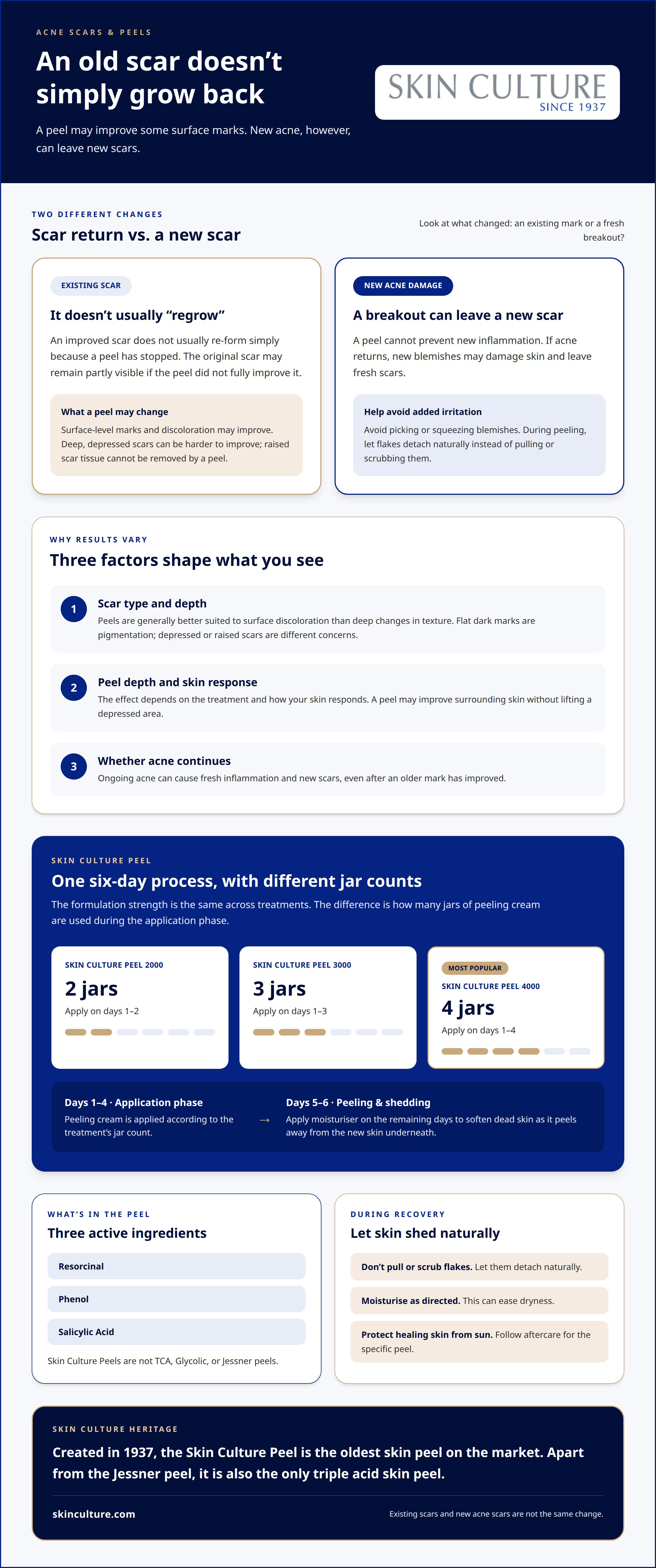
A peel may improve the appearance of acne scars, but it cannot prevent new ones from forming. So, will your acne scars come back after a peel? An existing scar does not simply regrow when skin sheds, but active or recurring acne can leave new scars.
It’s understandable to want lasting results, especially if scars have been difficult to treat. The type and depth of scarring matter: a peel may help with some surface-level marks and discoloration, while depressed scars can be harder to improve and may remain visible.
This article explains what a peel can and cannot change, why results vary, and how to care for your skin during recovery. It also outlines Skin Culture’s six-day at-home peel process and the differences between its peel strengths.
Key Takeaways
- Existing scars don’t simply grow back after a peel, but ongoing acne can leave new scars.
- Peels may improve surface-level marks and discoloration, while indented scars can be more difficult to address.
- How long resurfacing results last depends partly on the treatment and how the skin changes over time.
- Follow the recommended aftercare and protect healing skin from the sun to support recovery and help maintain results.
Are the Scar Removal Results of a Chemical Peel Permanent?
Chemical peels can improve acne scarring, but they don’t reliably remove every scar or restore skin completely. If you’re asking, “Will my acne scars come back after a peel?” an improved scar doesn’t usually regrow simply because treatment ends. Results depend on scar type, peel depth, and whether acne continues to cause inflammation.
How Long Superficial Peel Improvements Last
A superficial peel removes outer skin cells, which can soften the appearance of mild scarring and discoloration. Its improvement may fade as skin changes, while changes caused by peel agents don’t simply disappear when treatments stop. A series of peels may produce a more noticeable effect, but maintenance can matter. The benefit depends on the original concern and the skin’s response.
Scar Types and Peel Response
Peels are generally more suited to surface discoloration than deep changes in skin texture. Flat dark marks left after acne are pigmentation, not necessarily true scars, and may respond differently from indented or raised scars. A peel may improve the look of surrounding skin, but it cannot remove raised scar tissue and may have little effect on deep, depressed scars.
Scar Return and New Acne Scars
An improved scar does not usually re-form just because a peel has stopped. However, a peel cannot prevent new inflammation from causing additional scars. If acne returns, new blemishes may damage the skin and leave fresh scars, especially if you pick or squeeze them. Distinguishing an old scar from a new mark helps clarify what has changed.
In the United States, chemical peel costs vary with peel depth, treatment setting, and the treatment plan. There isn’t one price that applies to every acne-scar peel, and no particular amount can be assumed for an individual treatment.
There is no single session count for every acne scar. A dermatologist may recommend a series of 4 to 6 chemical peels, spaced a few weeks apart, to improve acne and related discoloration. The number and spacing depend on the peel and the skin concern being treated.
Suitability also depends on current skin condition and recent treatments. Chemical peels are typically not recommended when acne is active, because ongoing inflammation can continue to produce scars. Recent sun exposure within 4-8 weeks is also listed as a resurfacing contraindication. Peel depth, scar shape, skin healing, and previous procedures all affect the balance between potential improvement and irritation. A facial assessment can help determine whether a peel fits the concern, especially when scars are raised or deeply indented.
Post-peel care and sun protection
After a chemical peel, the surface barrier needs time to recover. Redness, tightness, and flaking can occur as treated skin sheds, and the recovery period varies with peel depth. A superficial peel usually causes scaling that clears within seven days. After a medium peel, crusting typically sheds over one to two weeks. Deep peels require more healing time, so aftercare must match the treatment rather than follow a single cosmetic routine.
Peeling often begins two to three days after treatment and may continue for two to five days, according to the Dermatology Center of Acadiana. Let flakes detach naturally. Pulling or scrubbing them can irritate fragile skin and may prolong visible redness. Use moisturizer as directed to ease dryness; the Dermatology Center of Acadiana says people with dry skin may moisturize twice daily after treatment, while people with normal or oily skin may moisturize once daily.
Sun protection is essential while skin heals. According to the Dermatology Center of Acadiana, use broad-spectrum SPF 30+ sunscreen every four hours after a chemical peel. Limit direct exposure as well, because recently treated skin is more vulnerable to irritation and discoloration. This matters particularly for people prone to hyperpigmentation: inflammation and ultraviolet exposure can make uneven tone more noticeable. After a medium peel, avoid sun exposure until the skin has healed completely. Deep peels require staying out of the sun for three to six months.
- Keep the treated area protected from direct sunlight during recovery.
- Use moisturizer rather than picking or scrubbing peeling skin.
- Follow the aftercare plan for the specific peel depth.
Patients should also allow healing to finish before restarting irritating skincare or scheduling another treatment. A salicylic acid peel, for example, still requires gentle care while the surface sheds. Don’t assume that less visible peeling means the skin has fully recovered. For a medium peel, makeup may be used to camouflage treatment effects after seven days; the skin’s healing status remains the important consideration.
Fillers address some indented scars, but they aren’t a substitute for post-peel care. Likewise, a new breakout during recovery can complicate the appearance of healing skin. Avoid squeezing blemishes, and keep the routine simple until peeling has ended. A careful recovery routine supports the skin’s barrier; it doesn’t guarantee that acne or hyperpigmentation won’t recur.
For a home treatment, the structured peel-care approach lays out distinct application and shedding phases, helping patients follow each stage without rushing the peeling process.
Depressed acne scars
Depressed acne scars form when inflammation damages the skin and healing does not restore its original surface. The resulting dips can be shallow or crater-like, changing facial texture even after active acne settles. Pigmentation is different: a flat dark mark changes skin color, while a depressed scar changes its contour. A peel’s surface-level shedding may improve discoloration without rebuilding lost support beneath an indentation.
A chemical peel removes layers of skin to encourage a fresher surface. That process can improve some uneven tone, but it doesn’t necessarily lift depressed areas. In fact, removing skin layers may compromise the appearance of indented scars rather than correct their depth. A superficial peel may also have little effect on depressed acne scars. The scar’s depth and shape therefore matter more than the visible peeling itself.
Deep, crater-like scars are especially difficult to improve with chemical peels alone. A peel may help the surrounding skin look smoother, yet the depression can remain because its structure extends below the surface being treated. Picking or squeezing an inflamed pimple can contribute to damage and scarring. Avoiding further trauma may reduce the risk of new marks, but it cannot erase an established indentation.
Different scar patterns call for different approaches. Indented scars may be treated with injectable fillers, with or without subcision. Laser resurfacing, dermabrasion, and microneedling are other options for skin concerns. For the deepest scars, one physician recommends combining chemical peels with 3-4 microneedling treatments. These examples show why treatment depends on whether the main concern is pigmentation, shallow texture, or a deep structural depression.
Before choosing an at-home peel for acne marks, consider whether acne is still active. Ongoing breakouts can cause fresh inflammation and new marks, while treating existing texture will not prevent that cycle. A dermatologist can assess scar depth, shape and skin condition to advise whether peeling is suitable or another approach may better address the concern, particularly for sharply indented or crater-like scars.
Set expectations around what a peel can change. It may improve nearby tone or surface smoothness, but that does not mean a deep scar has been removed. Track a specific concern, such as a brown mark beside an indentation, rather than judging both as one problem. This helps distinguish changes in pigmentation from persistent texture or damage beneath the skin’s surface.
How long resurfacing results may last
Resurfacing results may last around 8-10 years, depending on how the procedure is performed and how aggressively it treats the skin. That estimate describes resurfacing broadly, not every chemical peel or acne scar. A smoother appearance can persist even as skin changes, but a lasting improvement doesn’t mean every scar has disappeared. The technique, scar depth, and whether new acne develops all influence what you see over time.
Peel depth also affects the expected timeline. The Dermatology Center of Acadiana says results from a medium chemical peel last between two and six months. It also says follow-up sessions may be needed two to six times annually to maintain those results. These figures concern medium peels, so they shouldn’t be applied automatically to superficial treatments or other resurfacing procedures.
Superficial peels work closer to the skin’s surface, where they can improve uneven tone and mild texture changes. A series of regularly scheduled superficial peels may produce pleasing results, but maintenance can be part of the plan. For those seeking ongoing skin care and professional revitalization, full-service salons like Ritz Cabelo e Estética offer dedicated aesthetic treatments designed to help maintain a healthy, balanced complexion. The visible benefit depends on the original concern and the skin’s response. Dark marks and shallow irregularities may appear improved, while a deep indentation can remain visible despite a smoother surrounding surface.
Time also changes skin independently of a procedure. Collagen production naturally declines after age 30, which may make treated acne scars look deeper or more defined. This doesn’t necessarily mean a scar has returned. Rather, surrounding skin may lose support, changing the contrast between an indentation and nearby tissue. Comparing the same scar under consistent lighting can help distinguish a true change from differences in shadows or facial expression.
Acne activity is another factor. If breakouts continue after a peel, new inflammation can create fresh scars and change the overall appearance of the skin. A peel may improve existing marks, but it does not prevent future acne from affecting the skin.
Use these distinctions to interpret changing results:
- Existing scar: Its appearance may improve, while the underlying texture remains.
- New mark: A breakout after treatment can cause new discoloration or scarring.
- Changing skin: Age-related collagen changes can make an old indentation more noticeable.
For an individual resurfacing plan, a dermatology assessment should take account of peel depth, scar type, active acne and healing history. These factors help set realistic expectations for what a treatment may change, rather than treating one result or timeline as universal.
Can acne scars return after a chemical peel?
An improved acne scar does not usually reappear simply because a chemical peel has ended. Changes to the treated skin do not automatically disappear when treatment stops, but improvement does not mean every scar has been removed. A shallow mark may look less noticeable while an indentation or raised area remains. Lighting and changes in the surrounding skin can also affect how visible a scar appears.
New scarring is different from an old scar returning. Ongoing acne can cause fresh inflammation, which may leave additional scars. For example, a new breakout beside a treated mark can make the area look as though the original scar has worsened, even though the new spot is a separate change. Treating acne and treating existing scars address different concerns.
Active acne also affects peel suitability. Chemical peels are typically not recommended when acne is active, because new breakouts can continue the cycle of inflammation and scarring. Picking or squeezing blemishes can contribute to scar formation. For that reason, distinguish between a healed scar and a current lesion before considering resurfacing. The condition of the skin at treatment time matters alongside the scar’s shape and depth.
Scar type changes what it means for a mark to “return.” A flat, acne-related dark mark is mainly a color concern, while a depressed scar changes skin texture. A raised scar contains excess tissue from the healing process. A peel may improve some surface discoloration, but it cannot remove raised scar tissue and may not address deep depressions. If a dark mark fades while an indentation remains, the scar has not returned; different features are simply becoming more noticeable.
Keep the timeline and the cause separate. A resurfacing result may change as skin ages, and collagen naturally declines after age 30. That change can make an old indentation appear deeper without creating a new scar. By contrast, a new breakout followed by a new mark points to fresh acne-related damage. This distinction helps set realistic expectations for what a peel changed and what needs attention next.
To understand what has changed, note whether the mark was present before the peel, whether its color or contour changed, and whether new acne appeared afterward. These observations can help distinguish persistent texture, a changing appearance and new scarring. If breakouts continue, acne control is an important consideration before pursuing scar resurfacing.
Explore skin peel options for resurfacing as a next step for concerns about post-peel skin appearance.
Skin Culture Home Skin Peel
Skin Culture Home Skin Peel offers Skin Peel 4000, Skin Peel 3000, and Skin Peel 2000 for people considering a home peel to improve their skin’s appearance. Each follows a six-day process: days 1-4 are the application phase, followed by peeling and shedding on days 5-6. The number of peeling-cream jars used differs by option, while the formulation strength is the same.
Created in 1937, the Skin Culture Peel is the oldest skin peel on the market. Apart from the Jessner peel, it is also the only triple acid skin peel, with Resorcinal, Phenol, and Salicylic Acid as active ingredients. A peel may help improve some surface concerns, but it doesn’t prevent acne or guarantee that scars won’t form again.
For questions about which option fits your skin-peeling goals, contact Skin Culture Home Skin Peel.
Choose a Next Step That Fits Your Skin
If you’re still wondering whether acne scars will come back after a peel, base your next decision on the concern you want to address. Consider whether you want to improve the appearance of existing marks, manage ongoing breakouts or understand how your skin responds during recovery. A clear goal helps you approach your next skincare choice with focus, rather than expecting one treatment to address every concern at once.
Give yourself time to make that decision thoughtfully. Notice what has changed in your skin and what still concerns you, then use those observations to guide your next step. Informed choices are more useful than expecting an instant result, especially when acne and scarring involve different concerns.
For readers who are also exploring broader aesthetic treatments or cosmetic surgery, specialized clinics like Brazilian Medical Center offer dedicated clinical resources and pre-operative guidance to help patients prepare.
For questions about home peel options and choosing a direction for your skincare routine, contact Skin Culture Home Skin Peel. A considered approach can help you move forward with greater clarity and confidence.
Frequently Asked Questions
Do superficial scars return after chemical peels?
An improved superficial mark does not usually return merely because treatment ends. A flat brown mark may remain partly visible or appear more noticeable as the surrounding skin changes. A fresh blemish can also leave a new mark nearby, making the area seem unchanged. Compare the same spot in similar lighting, and note whether its position or contour has changed. This can help distinguish persistent discoloration from a newly formed scar.
Do All Acne Scar Treatments Have Long-Term Results?
No. Results vary with treatment type, depth, and the concern being addressed. A treatment that softens discoloration may not correct an indented scar, while maintenance sessions may be part of some superficial-peel plans. Ongoing acne can also create new marks after improvement. Think of “long-term” as the durability of a particular change, not a promise that every treatment prevents future scarring.
How do pre-peel prep and post-peel care help maximize results?
Before full-face use, complete the full 6-day patch test under the chin. Skin Culture peels are not suitable for those allergic to aspirin or resorcinol. After treatment, use SPF 30+ for at least 30 days, moisturize as directed, and don’t pick or pull peeling skin. These measures protect the recovering surface and reduce avoidable irritation; they can’t prevent new acne from forming.
So, if scars don’t literally return, why do some people feel like they do?
An old scar can look more noticeable when lighting, facial expression, or surrounding skin changes. For example, side lighting can cast a shadow inside an indentation that looks deeper than it does in even light. Collagen naturally declines after age 30, which may also make treated scars appear more defined. A new breakout can add a separate mark nearby, changing the overall appearance.
What Can I Expect During the Treatment?
A Skin Culture home peel follows a six-day cycle, with Peel Cream and Normalizer Cream use determined by the kit. Each Peel Cream application stays on the face for exactly 90 minutes, then is removed. Peeling develops gradually rather than changing the skin instantly. A brief hot, stinging sensation may occur for 15-20 minutes. The peel doesn’t replace care for active acne or deeper scars.
What Results Can I Expect From a Light Peel?
A light peel can refresh the skin’s surface and improve the appearance of mild discoloration or uneven tone. It’s less likely to change a deep depression, which involves a structural change below the surface. Skin Peel 2000 is the light-strength option, with two Peel Cream jars and four days of Normalizer. Individual results may vary, so assess tone and indentation as separate concerns.
Do chemical peels remove acne scars permanently or only improve their appearance?
Chemical peels may improve the appearance of some acne scars, but they do not reliably erase scar tissue permanently. Changes to treated skin do not automatically vanish when peeling stops, although the original contour may remain partly visible. New acne can create separate scars rather than making an old one return. Track color and texture separately: improved tone and a persistent hollow are different outcomes.
Which types of acne scars respond best to chemical peels?
Flat acne-related discoloration and mild surface irregularities are more likely to benefit from a peel than raised or deeply indented scars. A peel sheds outer skin cells, but it cannot remove raised scar tissue, and deep, crater-like scars are difficult to improve this way. Identify whether the concern is a brown mark, raised tissue or a hollow. That distinction helps set realistic expectations about what peeling can change.
Disclaimer
Testimonials are the individual experiences of those who have used our skin peels. Individual results may vary.