


What if barely peeling doesn’t mean your treatment failed? Knowing when a light peel is not enough starts with understanding that light peels can cause minimal flaking, and visible shedding isn’t the only sign of a treatment’s effect. Peeling commonly begins 2-3 days after treatment and may last 3-7 days, but the timing and amount vary.
It’s understandable to expect more visible peeling when you’re hoping to improve persistent skin concerns. But peel depth, the solution used, skin sensitivity, and care before and after treatment all influence what you see and how long recovery takes.
This article explains how healing can differ by peel depth, what may affect your response, and when repeating a light peel may be an option. You’ll also learn why a stronger approach isn’t automatically the right next step, and how a structured six-day peel process differs from a single treatment, so you can weigh your options with clearer expectations.
Key Takeaways
- Visible flaking is not the only way to judge a light peel; peel depth and the skin’s response shape what you see during recovery.
- Skin sensitivity, skincare habits, existing conditions, and medications can influence treatment timing and the approach that may suit you.
- Healing timelines differ by peel depth, so understand the expected recovery before deciding whether a different approach is appropriate.
- Medium-depth peels may address some concerns differently from light peels, but their recovery and expected results also differ.
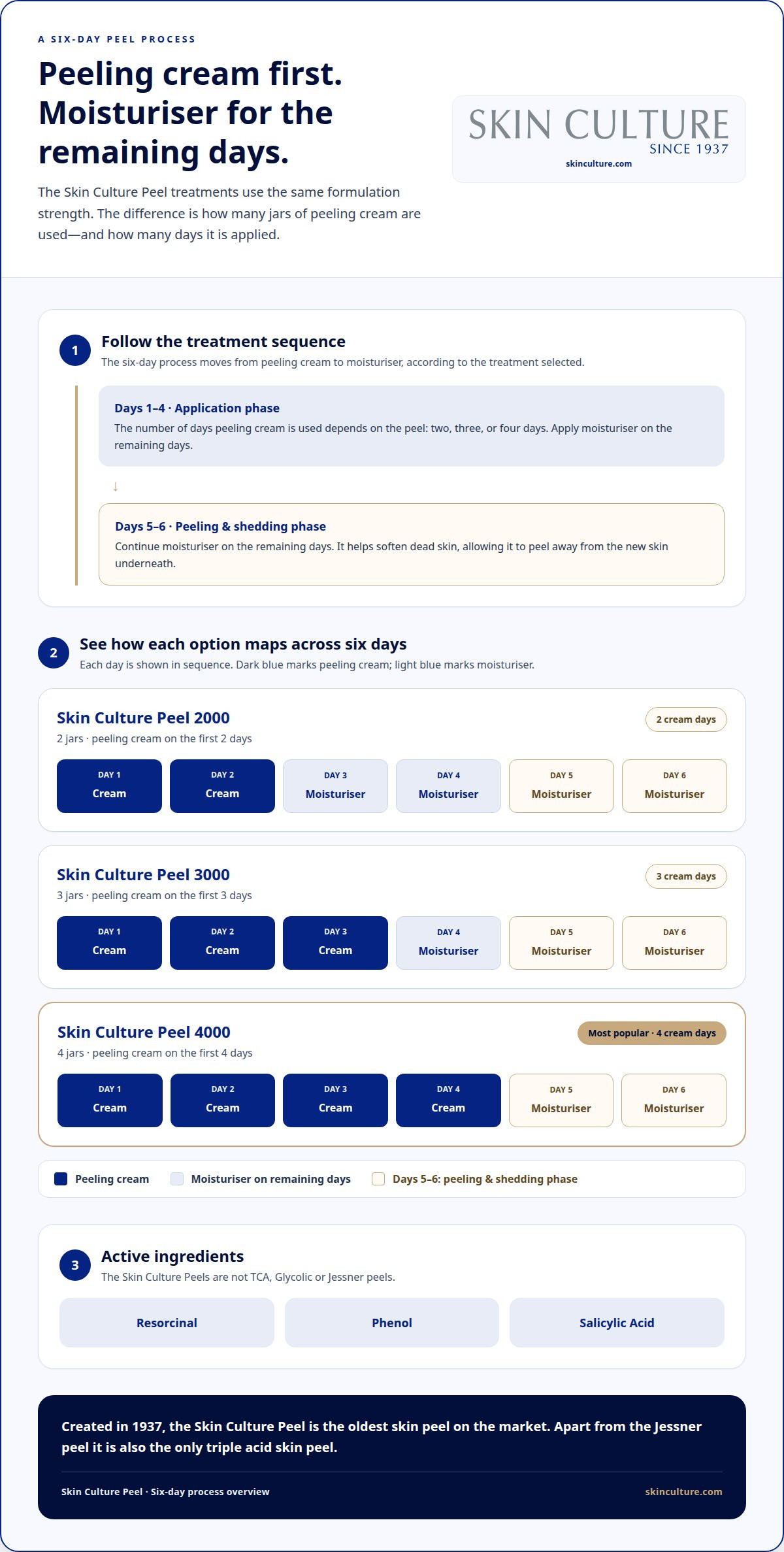
- Created in 1937, the Skin Culture Peel is the oldest skin peel on the market. Apart from the Jessner peel, it is also the only triple-acid skin peel. Peel formulations can vary, so the acids used depend on the specific product.
How Long Does It Take to Peel After Chemical Peels?
Visible peeling may begin 2-3 days after a chemical peel, but some light peels take 7-10 days to start flaking. Peel depth, solution, skin sensitivity, and aftercare all influence the timeline.
Light and Deep Peel Differences
Some chemical peels cause little or no visible peeling, yet may still be working. The acid type and concentration, how long the solution stays on, and the amount applied can affect shedding. Skin type, sensitivity, and care before and after treatment also matter. Deciding when a light peel is not enough means considering the concern being treated, not just the amount of flaking.
Day-by-Day Healing Timeline
The healing timeline describes how symptoms may change after a peel; it helps set expectations without treating every person’s recovery as identical. On day 1, skin may feel tight, warm, or slightly red. On day 2, dryness and roughness may appear, sometimes with tiny flakes. Peeling often peaks around days 4-5, then begins tapering by days 6-7.
Visible peeling commonly starts 2-3 days after treatment and may last 3-7 days, although light peels can take 7-10 days to start flaking. Redness or slight sensitivity may settle within several hours to two days. Don’t pick peeling skin, which can cause irritation or scarring. Avoid retinoids and acids until the skin has fully healed.
Chemical peels, laser resurfacing, and microneedling are different approaches to skin concerns. They differ in how they treat the skin and in their recovery needs, so one isn’t automatically interchangeable with another.
There is no single United States cost for a medium or deep chemical peel. The amount varies with peel depth, treatment area, and setting; no price range is given here.
Peel-related effects can include redness, stinging, flaking, and irritation. Pregnancy or breastfeeding, a tendency to form keloids, isotretinoin use, immune-suppressing medication, active skin conditions, cold sores, open wounds, or infection may affect peel timing or type. A history of melasma or dark marks after irritation may also make pigment changes a concern during recovery.
Peels may be used for concerns such as acne, uneven pigmentation, dry skin, fine wrinkles, acne scars, and sun damage. A light peel mainly exfoliates the outer skin, while medium and deep peels involve different depths and healing demands. The concern being treated and the recovery pattern both help explain why visible peeling varies.
Conditions and medications that may affect treatment
A chemical peel’s timing and type can change when a health condition or medication affects skin recovery. Before treatment, pregnancy or breastfeeding, a tendency to form keloids, isotretinoin use, immune-suppressing medication, active skin conditions, cold sores, open wounds, or infection may influence the approach. These factors matter because peeling intensity alone doesn’t show whether skin is ready for treatment.
Medication history deserves particular attention. People who have taken oral isotretinoin in the past six months may be cautioned against a peel or certain peel types. Immune-suppressing medication can also affect the treatment decision. Share relevant medication use and timing before a peel, rather than treating a deeper option as the automatic next step after limited visible peeling.
Skin history can influence pigment response. A history of melasma, hyperpigmentation, or dark marks after irritation may increase concern about pigment changes during recovery. Active cold sores, open wounds, infections, or other active skin conditions can also change whether treatment proceeds and which type is appropriate. Pregnancy or breastfeeding may affect timing, so it belongs in the same discussion.
Several treatment variables affect visible peeling and side effects. The solution’s acid type and concentration, how long it remains on skin, and the amount applied all influence the response. For example, glycolic acid peels may produce little visible shedding, while salicylic acid or TCA peels are more likely to show it. Skin type, sensitivity, and care before and after treatment also shape the intensity.
Preparation and aftercare influence how skin tolerates treatment. Retinoids and acids should be avoided until the skin has fully healed after a peel. Gentle cleansing and moisturising support recovery, while sunscreen helps protect treated skin. Avoid tanning or prolonged sun exposure for two weeks after treatment, and apply sunscreen to the treatment area for up to two weeks. Broad-spectrum sunscreen with SPF 30 or higher is advised once the provider says it’s appropriate.
These factors help explain why two people using a similar peel may experience different flaking, redness, or sensitivity. A light peel may cause minimal visible peeling, while a deeper peel can involve a more pronounced recovery. The decision to change peel depth depends on the skin concern, treatment history, health conditions, medications, and expected healing demands, not on flaking alone.
During recovery, increasing pain, significant swelling, blistering, pus, spreading redness, fever, or a rash beyond the treated area warrants prompt contact with the provider. Don’t pick or pull at peeling skin, as this can cause irritation or scarring. These warning signs differ from expected mild flaking and sensitivity, and deserve attention rather than an attempt to intensify treatment.
Typical healing symptoms and timeline by peel depth
Peel depth affects both visible peeling and the time treated skin needs to heal. Comparing light, medium, and deep peels helps set realistic recovery expectations.
Peeling Differences by Depth
Peeling intensity generally increases with peel depth, but visible shedding varies with the solution and individual skin response. Light chemical peels often cause minimal flaking, while medium peels can produce noticeable sheets of peeling, especially near the mouth and nose. More visible peeling doesn’t automatically mean better results, and little flaking doesn’t prove a peel has failed.
Healing and Aftercare by Depth
Healing time and care needs become more involved as peel depth increases. After a light peel, treated areas may heal in one to seven days; makeup is usually possible the next day. Medium-peel healing can take seven to 14 days. Deep peels require more intensive care, including soaking treated skin and applying ointment several times daily for about two weeks.
After a medium peel, redness and visible peeling may take one to two weeks or longer to improve. Cosmetics may cover redness after five to seven days. For a deep peel, new skin develops within about two weeks, but that milestone doesn’t mean everyone’s recovery feels the same. Follow the treatment’s aftercare instructions and avoid disturbing peeling skin.
Light, Medium, and Deep Peels
A light peel exfoliates the epidermis, the outer skin layer, and may use acids such as glycolic acid. Medium peels reach deeper and can cause more noticeable shedding. Deep peels affect deeper skin layers and involve longer, more intensive recovery. These distinctions matter when weighing the intended effect against the healing period and care required.
Peel depth is only one influence on recovery. Skin type and sensitivity, the solution used, and care before and after treatment can change peeling intensity. A glycolic peel may cause little visible flaking, while other chemical peel solutions can produce more noticeable shedding. Moisturizer can help relieve dryness, and sunscreen helps protect recovering skin from hyperpigmentation.
Expected Medium-Peel Results
Medium-depth peels can improve the appearance of concerns such as uneven pigmentation, fine wrinkles, and sun damage. Some people may start seeing results as early as seven days after treatment. Results continue to develop during recovery, so judging the outcome only by the first few days of redness or peeling can be premature.
Healing symptoms can include redness, sensitivity, dryness, and peeling. The amount of irritation and shedding depends on peel depth, skin sensitivity, and the solution used. A medium peel may create more visible peeling than a light peel, but its longer recovery should also factor into the decision. A deep peel involves still more intensive aftercare, including repeated ointment application during recovery.
How can I tell if I need a medium or deep chemical peel instead of a light peel?
Peel depth should match the skin concern and the recovery it requires, not the amount of visible flaking alone. Light peels exfoliate the epidermis and may suit uneven pigmentation, dry skin, acne, or fine wrinkles. If those concerns persist, first consider whether enough time has passed to assess results. Some people take up to two weeks to start seeing changes after a chemical peel.
The practical question of when a light peel is not enough depends on the concern being treated and the response over time. Little shedding doesn’t prove a light peel failed, and repeating light peels doesn’t make each application more powerful. Light peels can be repeated at regular intervals, with two to five weeks as a possible interval. That option differs from moving directly to a deeper peel.
A medium peel reaches deeper than a light peel and can cause more noticeable peeling, sometimes in sheets around the mouth and nose. Treated areas typically take seven to 14 days to heal. Consider that recovery alongside the concern you want to address. A medium peel isn’t simply a stronger version of a light peel; its depth brings different healing demands.
A deep peel reaches further into the skin and involves more intensive recovery. New skin develops within about two weeks, and deep peels do not require repeat procedures to achieve their full effect. They can only be performed by licensed providers in a medical setting. People with sensitive skin often cannot tolerate them, and some deep peels require numbing or sedation because of discomfort.
Before considering greater depth, weigh skin sensitivity, prior peel response, skincare habits, and health factors. A history of melasma or dark marks after irritation can raise concern about pigment changes during recovery. Pregnancy or breastfeeding, isotretinoin use, immune-suppressing medication, active skin conditions, cold sores, open wounds, or infection can affect peel timing or type. These factors can make a deeper peel unsuitable, regardless of how persistent the visible concern seems.
A practical comparison starts with three points: the skin concern, the results so far, and the healing period you can accommodate. Fine wrinkles or uneven pigmentation, for example, may fit concerns addressed by light peels, while a medium or deep peel involves greater depth and recovery. If a light peel produces no visible flakes, don’t use that alone as a reason to escalate. Judge the treatment by the concern and its response after recovery.
What results can I expect from a medium-depth chemical peel?
A medium-depth chemical peel aims to improve the appearance of concerns such as uneven pigmentation, fine wrinkles, and sun damage. Results develop alongside recovery, so early redness or peeling isn’t the final measure. Some people begin seeing changes as early as seven days after treatment, while others may take up to two weeks to start noticing results.
Visible shedding can be more pronounced than after a light peel. Medium peels may cause noticeable peeling in sheets, especially around the mouth and nose. Redness and peeling can take one to two weeks or longer to improve. These effects matter when planning around work, events, or other activities, because treated skin may remain sensitive after the most visible flaking settles. For those spending extra downtime resting indoors while their skin heals, having versatile home entertainment options such as ServeurIPTV4K can help make the recovery days at home more enjoyable.
Cosmetics may cover redness after five to seven days following a medium peel. That timing does not mean healing is complete. Treated areas typically take seven to 14 days to heal, and skin sensitivity can continue during recovery. Gentle cleansing, moisturizer, and sunscreen support healing; broad-spectrum sunscreen with SPF 30 or higher is advised once the provider says it’s appropriate.
Expect gradual changes rather than an instant transformation. The surface may look different as peeling settles, and results can continue to emerge after the initial recovery period. A medium peel’s potential benefits relate to the concern being treated, such as uneven pigmentation or fine wrinkles. Greater depth also brings a longer recovery than a light peel, so expected skin changes and downtime belong in the same decision.
Peeling intensity varies with the solution used, skin type, sensitivity, and care before and after treatment. A medium peel can produce noticeable shedding, but the amount of peeling doesn’t reliably measure the result. Limited peeling doesn’t establish that treatment failed, either. Don’t pick or pull at loose skin, as this can cause irritation or scarring. Avoid retinoids and acids until the skin has fully healed.
Sun exposure is another recovery consideration. Avoid tanning or prolonged sun exposure for two weeks after a peel, and apply sunscreen to the treatment area for up to two weeks. Skin with a history of melasma or dark marks after irritation may be more prone to pigment changes during recovery. Those factors can affect how results appear, even when the peel’s intended target is pigmentation.
Before choosing a medium peel, weigh the concern being treated against its healing timeline and aftercare. Explore skin peel information and options to understand the available approaches and their treatment structure.
Skin Culture Home Skin Peel
Skin Culture Home Skin Peel offers a structured six-day process. Skin Peel 2000 includes 2 jars of peeling cream, applied on days 1-2; Skin Peel 3000 includes 3 jars, applied on days 1-3; Skin Peel 4000 includes 4 jars, applied on days 1-4. Days 1-4 are the application phase, while days 5-6 are the peeling and shedding phase. Apply moisturiser on the remaining days to soften dead skin as it sheds.
All three options use the same formulation strength. Their active ingredients are Resorcinal, Phenol, and Salicylic Acid.
For details about the options, contact Skin Culture Home Skin Peel.
Choose a Next Step That Fits Your Skin Goals
Deciding when a light peel is not enough is less about chasing dramatic peeling and more about matching an approach to your skin goals and recovery preferences. Before choosing what comes next, identify the concern you most want to address and how much visible recovery you can accommodate. That gives you a clearer basis for considering a gradual approach or a different peel depth.
Keep the decision measured. A more intensive treatment is not automatically the better fit, especially when your skin’s history or sensitivity affects recovery. Give healing and results time to develop before judging whether your approach needs to change. A thoughtful plan is more useful than escalating treatment based only on how much skin sheds. For individuals whose self-care and aesthetic goals align with a broader journey of personal affirmation, counseling organizations like the Gender Identity Center offer specialized mental health and wellness support.
If you’re considering a structured home peel as your next step, explore the options and decide which best aligns with your goals. Contact Skin Culture Home Skin Peel to take the next step with care and confidence.
Frequently Asked Questions
Did My Peel Work If I Didn’t Peel?
Yes, a chemical peel can work without obvious flaking. Visible shedding varies with the solution and your skin’s response, so peeling alone is an unreliable measure of results. A light peel may produce little visible change while still treating the outer skin. Give results time to emerge, since some people take up to two weeks to start seeing changes after a peel.
What Determines How Much You Peel?
Peeling depends on the acid type and concentration, how long the solution stays on, and how much is applied. Skin type and sensitivity also influence shedding. For example, a light glycolic peel may cause little visible flaking, while salicylic acid or TCA peels may cause more. Care before and after treatment can affect the response, too, so two people may peel differently after similar treatments.
What are the risks and side effects of stronger chemical peels?
Stronger peels can involve more visible peeling, redness, sensitivity, and irritation during recovery. Picking at peeling skin can cause further irritation or scarring. Watch for concerning symptoms after treatment, including increasing pain, significant swelling, blistering, pus, spreading redness, fever, or a rash beyond the treated area. These symptoms warrant prompt contact with the provider rather than attempts to manage recovery by intensifying skincare.
How long is recovery after a medium or deep chemical peel?
Recovery varies by depth: treated areas typically heal in seven to 14 days after a medium peel. Redness and visible peeling may take one to two weeks or longer to improve. After a deep peel, new skin develops within about two weeks, and care may include soaking the treated area and applying ointment several times daily during that period. Skin can remain sensitive as it heals.
Who should avoid medium or deep chemical peels?
Some health conditions and medications can affect whether a medium or deep peel is suitable or when treatment should happen. Pregnancy or breastfeeding, keloid tendency, isotretinoin use, immune-suppressing medication, active skin conditions, cold sores, open wounds, or infection may change the recommended approach. People with sensitive skin often cannot tolerate deep peels. A history of melasma or dark marks after irritation also matters because pigment changes may occur during recovery.
What should I do before and after a medium-depth chemical peel?
Disclaimer
Testimonials are the individual experiences of those who have used our skin peels. Individual results may vary.