


Getting my skin ready for a big event starts with a steady routine begun a few weeks ahead, not a last-minute overhaul. Keep cleansing and moisturizing consistent, avoid over-exfoliating, and stick with familiar products to reduce the risk of irritation.
It’s understandable to want smoother, brighter-looking skin by the event, especially if a pimple or uneven texture appears at the wrong time. A measured approach gives your skin time to settle and helps you make choices that support it rather than disrupt it.
Here, you’ll find a practical timeline for event skincare, guidance on using serums after exfoliation, and simple steps for managing blemishes and caring for your skin at home. You’ll also learn why a new or intensive treatment is best planned well before the event, rather than added at the last minute.
Key Takeaways
- Build a steady routine well before your event, and leave time for skin to settle after treatments rather than making last-minute changes.
- After exfoliation, keep the next steps gentle and choose serums that suit your skin; too much exfoliation can leave skin irritated.
- For a pimple, resist picking at it. A hydrocolloid patch can protect the spot overnight while it heals.
- Keep at-home care simple with regular cleansing and moisturizer, and use products you already know your skin tolerates.
- Skin Culture Peels follow a six-day process, with application followed by peeling and shedding. Created in 1937, the Skin Culture Peel is the oldest skin peel on the market. Apart from the Jessner peel it is also the only triple acid skin peel.
1. Using serums and boosters after exfoliation
Exfoliation removes dry, damaged, or dead cells from the skin’s surface. After cleansing, use a gentle exfoliant according to its directions, then apply a hydrating serum or booster to clean skin. This order clears surface buildup before your leave-on products. Choose a formula your skin already tolerates, such as a simple hydrating serum, rather than adding several new active ingredients before an event.
Keep exfoliation measured. A general routine may include gentle exfoliation twice a week, but skin sensitivity and exfoliant strength matter. More frequent use can cause discomfort, redness, or irritation. Don’t combine several exfoliating products in one session. For example, avoid layering a scrub with an acid exfoliant and then adding a strong active serum. If your skin feels sore or looks red, pause exfoliation and return to gentle cleansing and moisturizer.
Timing matters before makeup. Gucci Westman uses gentle exfoliation on the day of an event to smooth dead skin cells and prepare a base for makeup. That approach isn’t suitable for every complexion. If exfoliation is new to your routine, test it well before the event rather than on the day. Dr. Rosemarie Ingleton leaves a fruit-acid cleanser on her skin for one to two minutes before rinsing, illustrating why product directions and contact time matter.
After exfoliating, rinse thoroughly if the product requires it, pat your face dry, then apply serum with clean hands. Follow with moisturizer for a smoother surface. Give each layer time to settle before applying foundation. Flaky or separating makeup can follow dry, irritated skin or heavy product layering. Don’t scrub flakes away; apply a light moisturizer before primer instead.
There isn’t one typical cost for professional facials or event-prep skin treatments. The amount varies with the treatment, its intensity, and what the session includes, so a facial and a more involved treatment may differ considerably.
For sensitive or acne-prone skin, cleanse gently and stick with familiar products. Avoid picking active pimples, and don’t introduce harsh exfoliants or unfamiliar serums close to the event. A hydrocolloid patch can cover a blemish overnight while it heals. If exfoliation is already part of your routine, don’t increase its frequency for a special occasion.
A facial can include exfoliation, but it shouldn’t leave your skin visibly irritated before an event. Choose gentle steps that suit your complexion, then keep the rest of your routine simple. This measured approach helps you prepare your skin for makeup without turning exfoliation into a last-minute experiment.
2. A wedding and event preparation timeline
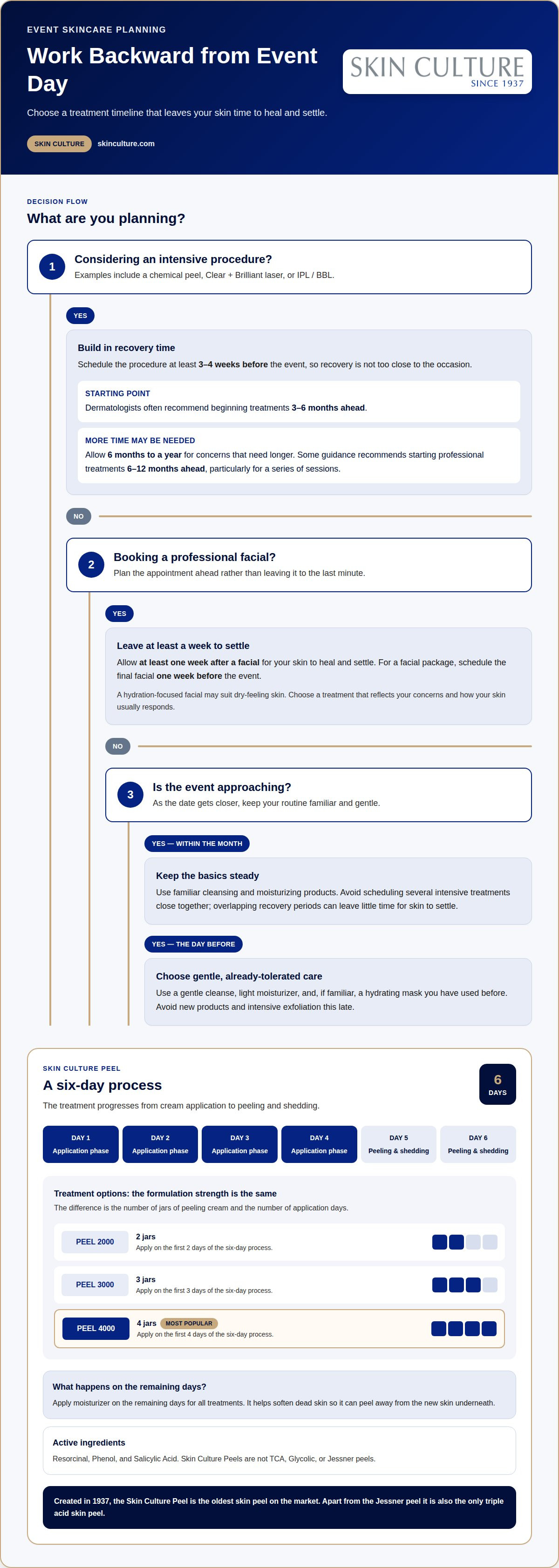
Plan around the treatment you want and the time your skin needs to settle. Dermatologists often recommend beginning treatments three to six months before a major event because visible changes in collagen, pigmentation, and wrinkles develop gradually. For concerns that need more time, allow six months to a year. Some guidance recommends starting professional treatments six to twelve months ahead, particularly if your plan involves a series of sessions.
Build your calendar backward from the event date. First, identify your main concern, such as uneven texture or dehydration. Then choose a routine you can maintain without introducing several active products at once. If you’re considering a procedure such as a chemical peel, Clear + Brilliant laser, or IPL or BBL, schedule it at least three to four weeks before the event. That gives your skin time to heal instead of putting recovery close to the occasion.
For a professional facial, plan ahead instead of booking at the last minute. Schedule the final facial in a package one week before your event, and allow at least a week after a facial for your skin to heal and settle. This leaves time for temporary redness or sensitivity to resolve. A facial focused on hydration may suit dry-feeling skin; choose a treatment that reflects your concerns and how your skin usually responds.
In the month before the event, keep the basics steady. Keep your skincare routine steady with familiar cleansing and moisturizing products. Hydration and a consistent routine support a smoother-looking base without the uncertainty of sudden changes. Avoid scheduling several intensive treatments close together; overlapping recovery periods can leave little time for your skin to settle.
The day before an event, choose familiar, gentle care. A hydrating mask you’ve used before can add moisture, while a gentle cleanse and light moisturizer help keep your skin comfortable. A face mask is suggested a day or two before an event, but avoid harsh treatments or new products this late. For many people, a calm routine is safer than trying to create a dramatic change overnight.
So, what skincare treatments are safe the day before? Stick to familiar, non-irritating steps, such as gentle cleansing, moisturizer, and a previously tolerated hydrating mask. Avoid new products and intensive exfoliation, which can leave skin red or irritated when makeup needs to sit smoothly.
4. At-home skincare routine
A consistent skincare routine gives you a predictable foundation before an event. In the morning, cleanse gently, apply vitamin C serum, then use moisturizer. Apply eye cream in your usual order, before or after moisturizer as directed. Keep the sequence simple and familiar. Adding several products at once makes it harder to identify what may be irritating your skin.
In the evening, remove makeup and sunscreen with a double cleanse: use a first cleanser, then follow with a second. Finish with moisturizer to ease any dry, tight feeling after cleansing. If you don’t wear makeup, keep the same evening steps but choose cleansers that feel comfortable on your skin. Apply eye cream morning and evening if it’s already part of your routine.
Retinoids can increase cell turnover and help keep pores clear, but event preparation isn’t the time to introduce an unfamiliar active ingredient. A new product may irritate your skin, especially when combined with other strong treatments. If you already use a retinoid, follow your established routine rather than increasing application frequency. Avoid adding new or harsh skincare products immediately before the event.
For an isolated pimple, leave it alone instead of squeezing or picking. Picking can worsen inflammation and raise the risk of scarring. Apply a hydrocolloid patch overnight to absorb fluid and protect the spot as it heals. Don’t cover it with multiple strong treatments. If a blemish appears just before the event, protecting it is a better at-home step than trying to force it to disappear.
A weekly mask can add a deliberate hydration step during the month before an event. The suggested application lasts 20 minutes to two hours, depending on the mask’s directions. Choose a hydrating formula you’ve used before, and rinse it off as directed. A mask should complement cleansing and moisturizer, not replace either. Avoid testing a new formula shortly before the occasion.
On the event morning, keep your routine light: cleanse gently, apply moisturizer, then use primer before makeup. Give each layer time to settle instead of applying foundation over wet skincare. At night, remove makeup with a double cleanse and moisturize. These repeatable steps keep your routine orderly, while familiar products limit last-minute changes that could leave your skin uncomfortable.
4. Which skincare ingredients help with hydration and a smoother complexion?
For a hydrated-looking complexion, start with a mask labeled for hydration. A hydrating mask adds moisture, making it a practical option when your face feels dry or tight. Follow the directions, then apply your usual moisturizer. This simple pairing adds a focused moisture step without requiring a complicated formula or a new series of products.
Ingredient labels can help you choose a formula. Look for familiar moisturizing ingredients, such as glycerin or hyaluronic acid, in a serum or mask you already tolerate. These humectants attract and hold water in the skin’s outer layers. A moisturizer can then help ease the dryness that makes surface texture more noticeable. Keep the sequence straightforward: cleanse, apply the hydrating product, and finish with moisturizer.
For a smooth makeup base, hydration is only one part of the routine. Dry patches can make foundation sit unevenly, while too many layers can feel heavy. Apply a thin layer of serum or mask as directed, let it settle, then use moisturizer. If a product leaves residue, use less rather than adding another layer. The aim is comfortable skin, not a stack of formulas.
Vitamin C serum is another ingredient-based step for the morning routine. Apply it after cleansing and before moisturizer, following the product’s directions. If your current serum suits your skin, keep using it consistently instead of switching formulas before an event. A new serum adds an unfamiliar variable, especially if your complexion is sensitive or prone to blemishes.
Match the product texture to how your skin feels. A lightweight serum may work under moisturizer when your skin feels slightly dry, while a richer moisturizer may feel more comfortable when tightness persists. For example, use a hydrating mask when your face feels parched, then return to your regular moisturizer. Avoid combining a mask, serum, and several new treatments to chase a quick change.
Test any unfamiliar hydrating product during your normal routine, not immediately before makeup. Apply it as directed and observe how your skin feels afterward. If redness, stinging, or discomfort appears, stop using it and return to familiar products. A well-chosen hydrating mask, a tolerated serum, and moisturizer offer a measured approach to a smoother-looking surface without turning preparation into product experimentation.
5. How long before an event should I avoid trying new skincare products?
Keep unfamiliar skincare products out of your routine as the event approaches. The closer the occasion, the less time you have to notice irritation, stop using the product, and let your skin settle. There’s no single cutoff that suits every formula or complexion. A cleanser, serum, exfoliant, or mask can affect skin differently, so safe timing depends on the product and your past reactions.
Use a familiar routine throughout your final preparations. Gucci Westman recommends trusted skincare before an important event instead of experimenting with something new. For example, keep your usual cleanser, moisturizer, and makeup primer rather than replacing them with newly purchased versions. If you want to try a different serum, introduce it well ahead of the occasion, when you can observe how your skin responds without disrupting event-day plans.
Be especially cautious with products labeled exfoliating, resurfacing, or intensive. A new acid serum or scrub may cause redness or discomfort, and adding it alongside established products makes it harder to identify the cause. Don’t test a new exfoliant the night before a wedding or party. Keep that evening’s steps simple: cleanse with a familiar formula and apply your regular moisturizer.
Make a small product-change plan. Choose one new item at a time, use it as directed, and avoid changing other parts of your skincare routine simultaneously. Note whether you experience stinging, redness, dryness, or a breakout. If a reaction develops, stop the new product and return to familiar steps. Don’t add more active ingredients to compensate, as extra products can further complicate your routine.
For sensitive or acne-prone skin, consistency matters more than novelty. Keep using products your skin already tolerates, and avoid experimenting with harsh treatments immediately before the event. If a blemish appears, don’t pick it or add several spot treatments at once. A hydrocolloid patch can protect the area overnight as it heals. Makeup also sits more predictably on skin that hasn’t been irritated by unfamiliar products.
Give new skincare a place in your routine only when you have time to observe its effects. Review your current products, keep the final event-preparation steps familiar, and make any changes gradually rather than all at once. Explore a considered approach to skincare as you plan your routine.
Begin an event-preparation skincare routine a few weeks before the occasion, avoid over-exfoliation to limit redness or irritation, and get at least 6-8 hours of sleep nightly during the month before.
Skin Culture Home Skin Peel
Skin Culture Home Skin Peel offers a structured at-home peeling treatment for concerns such as acne scars, fine lines, and sun damage. The six-day process has an application phase on days 1-4, followed by peeling and shedding on days 5-6. Plan it well ahead of an event so the full process doesn’t overlap with the occasion.
Skin Peel 2000, Skin Peel 3000, and Skin Peel 4000 use the same formulation strength; they differ in the number of peeling cream jars applied during the first days. Skin Peel 4000 is the most popular option. Created in 1937, the Skin Culture Home Skin Peel is the oldest skin peel on the market. Apart from the Jessner peel it is also the only triple acid skin peel.
If this process fits your event timeline, contact Skin Culture Home Skin Peel to discuss the options.
Make your next skincare choice with a clear plan
Getting my skin ready for a big event is easier when I decide what matters most before changing my routine. Choose one priority, such as comfort, hydration, or a more even-looking surface, then consider whether your current skincare supports it. If you’re considering a home peel, factor in your event schedule and your willingness to follow a structured treatment. A deliberate choice leaves less room for last-minute experimentation and keeps preparation focused on what feels appropriate for your skin.
Skin Culture Home Skin Peel can help you explore its at-home peel options as a possible next step. Share your event-preparation goals and ask about the available choices to decide whether one fits your plans. Contact Skin Culture Home Skin Peel to discuss your next step. Thoughtful preparation starts with a choice you can make calmly, and your skin routine can build from there.
Frequently Asked Questions
How far in advance should I start preparing my skin for a big event?
For getting my skin ready for a big event, start several months ahead if your goals include gradual changes to collagen, pigmentation, or wrinkles. Dermatologists often recommend beginning treatments 3-6 months before a major event; more extensive treatment plans may start 6-12 months ahead. For a simpler at-home routine, begin a few weeks beforehand. That gives you time to settle into familiar steps and avoid rushed changes as the event approaches.
What is a simple pre-event skincare routine for glowing skin?
A simple routine for getting my skin ready for a big event is to cleanse, apply familiar skincare, and moisturize. In the morning, vitamin C serum can follow cleansing; in the evening, remove makeup with a double cleanse. Choose a hydrating mask you’ve used before if your skin feels dry, and avoid layering unfamiliar products. For event-day makeup, let each skincare layer settle before applying primer or foundation.
Should I get a facial before an event, and how many days beforehand?
A facial can suit your plans if it addresses a specific concern, such as hydration, but book it at least a week before the event. That gives your skin time to heal and settle. Choose a familiar, gentle treatment rather than trying an intensive facial for the first time right before a wedding. If you’ve had a facial before, consider how your skin responded when choosing the treatment and timing.
What are the risks of chemical peels, retinoids, or exfoliation before an event?
Exfoliation and unfamiliar active products can cause redness or irritation, which may make makeup harder to apply smoothly. Retinoids increase cell turnover, so don’t add one suddenly to an event-preparation routine. Chemical peels and treatments such as Clear + Brilliant laser or IPL/BBL should be scheduled at least 3 to 4 weeks before an event to allow healing. Avoid combining new or intensive steps close to the date.
How can I reduce a pimple or redness quickly before an event?
Don’t pick or squeeze a pimple, since this can worsen inflammation and increase scarring risk. A hydrocolloid patch can protect a blemish overnight while it heals. For a cystic acne lesion, a dermatologist can inject a small amount of corticosteroid to flatten it within 24-48 hours. Avoid trying several spot treatments at once, which may irritate the surrounding skin and make redness more noticeable.
Disclaimer
Testimonials are the individual experiences of those who have used our skin peels. Individual results may vary.