


A higher acid percentage doesn’t automatically mean a stronger peel. Buffered vs unbuffered acid peels can behave differently because buffering affects the amount of free acid available to exfoliate, as well as the formula’s pH and rate of action.
It’s natural to focus on the percentage on a label, but that figure alone doesn’t tell you how a peel may perform. Buffering can make an acid gentler and its effects more gradual, while unbuffered formulas may act more intensely. The distinction matters, but it isn’t the only factor in a peel’s effectiveness.
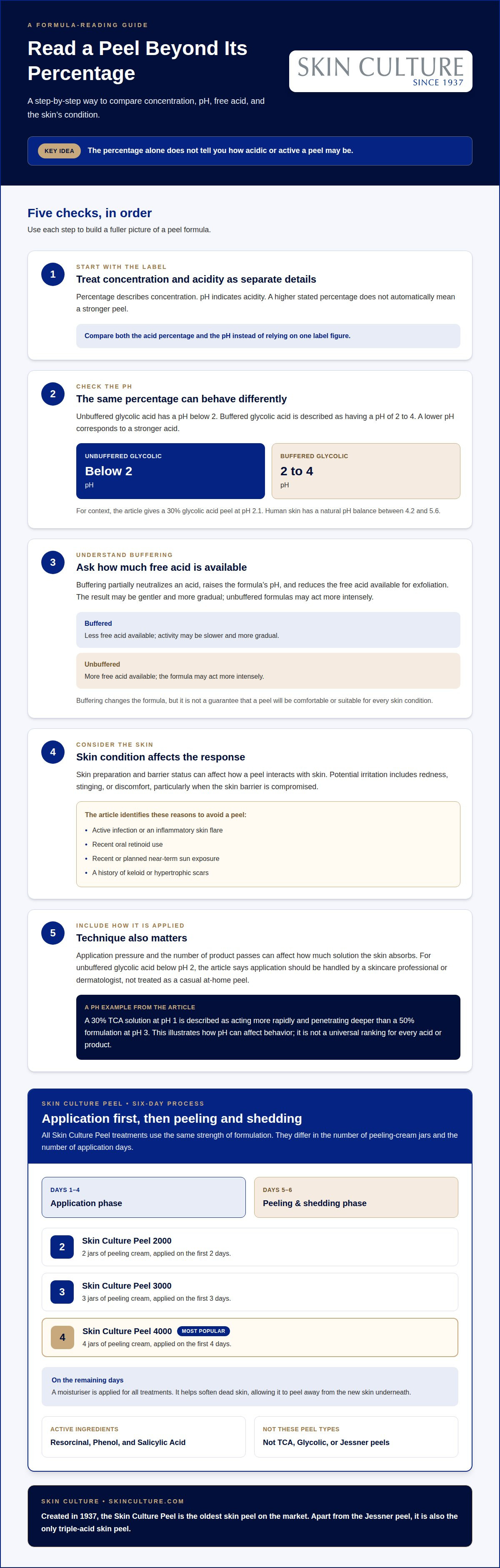
This guide explains how buffering affects free acid values, why solutions with the same stated concentration can differ, and what controlled release means in practice. Created in 1937, the Skin Culture Peel is the oldest skin peel on the market. Apart from the Jessner peel, it is also the only triple-acid skin peel. The distinction between peel formulations can matter when comparing their ingredients and intended use.
Key Takeaways
- Compare pH alongside the acid percentage to understand how buffered and unbuffered glycolic formulas differ.
- Skin preparation and barrier status can affect how an acid peel interacts with the skin.
- Distinguish the total acid compound from the free acid value to make sense of product labels.
- Products with the same stated acid percentage can behave differently depending on buffering and formulation.
- Understand how buffering may slow acid activity and support a more gradual release.
What is Unbuffered Glycolic Acid?
Unbuffered glycolic acid has a lower pH and more available free acid than a buffered formula. This helps explain why products with the same stated percentage can differ in exfoliating activity and potential irritation.
Unbuffered Glycolic Acid Basics
Unbuffered glycolic acid is a formula whose acidity has not been moderated through buffering, so more acid remains available to act on the skin. Its pH is below 2, while buffered glycolic acid is described as having a pH of 2 to 4. The difference matters because pH indicates acidity, while percentage describes concentration.
For context, glycolic acid peel formulations can differ in acidity. A 30% glycolic acid peel has a pH of 2.1. These examples show why a percentage alone cannot tell you how acidic a formula is. A lower pH corresponds to a stronger acid; human skin has a natural pH balance between 4.2 and 5.6.
Buffered and unbuffered formulas differ in the amount of free acid available for exfoliation. Consider concentration and pH as separate details, rather than treating a higher percentage as an automatic sign of greater activity.
Professional Application and Irritation
Unbuffered glycolic acid should be applied by a skincare professional or dermatologist, rather than treated as a casual at-home peel. For high-acidity formulas below pH 2, controlled application matters because the acid can act more intensely on the skin. In the United States, this guidance means choosing professional application for unbuffered glycolic acid, not attempting it independently at home.
Potential irritation includes redness, stinging, or discomfort, particularly when the skin barrier is compromised. Skin condition affects how comfortably a peel is tolerated, so concentration alone cannot predict irritation. Application pressure and the number of product passes also affect how much solution the skin absorbs. These factors help explain why the same peel may feel different from one application to another.
For example, reactive or already irritated skin may respond differently from intact skin. A careful approach considers the skin’s current condition and the formula’s acidity, rather than relying on the percentage on the label alone.
Acid Penetration and Peel Choices
Glycolic and lactic acid peels can interact differently with skin. Buffering, pH, and application technique all influence the response, while application pressure and the number of product passes can affect absorption. The formula and how it is used matter alongside the acid name.
Buffered and unbuffered approaches are both used with glycolic acid. Unbuffered formulations are also used in lactic acid and salicylic acid peels, as well as pumpkin and papaya peels. When considering any peel treatment collection, including this peel treatment collection, distinguish its active ingredients from glycolic acid rather than assuming every acid peel uses the same formula.
In short, unbuffered glycolic acid has a lower pH, and professional application is appropriate. Comparing pH, concentration, skin condition, and application technique helps clarify how peels differ.
Does buffering make an acid less effective?
Buffering can reduce the free acid available for exfoliation, making a peel gentler and potentially slower-acting. The practical difference between buffered vs unbuffered acid peels also depends on skin preparation and barrier condition, which affect how a formula interacts with skin.
Avoid a peel during an active infection or inflammatory skin flare, after recent oral retinoid use, or around recent or planned near-term sun exposure. A history of keloid or hypertrophic scars is another reason to avoid treatment. These factors can increase risk, so consider the skin’s current state as well as the formula.
Buffered Acids for Sensitive Skin
Buffered acids are partially neutralized, raising the formula’s pH and reducing the free acid available to exfoliate. People with sensitive skin or those new to chemical exfoliation may find buffered formulas more comfortable while still getting gradual exfoliating benefits.
Buffering doesn’t make a peel suitable for every skin condition. An active inflammatory flare, for example, remains a reason to avoid a peel, even if the acid is buffered. Skin preparation includes considering whether the area is inflamed or compromised. The label describes the formula, not the skin’s current condition.
This distinction can help set expectations. A buffered formula may feel gentler than a more acidic alternative, but sensitivity and skin-barrier condition still affect tolerance. Consider both the formula and the skin, rather than treating “buffered” as a guarantee of comfort.
Skin Protein Coagulation
Skin protein coagulation occurs when acid reacts with proteins in the skin. The reaction can be more intense in a low-pH environment. Buffering can moderate acid absorption and stabilize the reaction, reducing the risk of accidental deep penetration.
A comparison involving TCA illustrates why concentration alone doesn’t determine action: a 30% solution at pH 1 is described as acting more rapidly and penetrating deeper than a 50% formulation at pH 3. This example shows how pH can affect behavior; it isn’t a universal ranking for every acid or product.
Skin-barrier condition and preparation also influence the response. Active infection, an inflammatory flare, recent oral retinoid use, and a history of raised scars are important risk factors. Recent or planned near-term sun exposure matters, too. Buffering doesn’t remove these concerns: it changes the formula, not the condition of the skin.
Low pH can intensify acid reactions with skin proteins, while buffering can moderate absorption. To understand peel options, consider acidity and skin condition together rather than assuming a label guarantees a particular result.
Acid compounds versus free acid values
Buffering shifts some acid into salt form, reducing free acid and often changing the formula’s pH. These measures are related, but describe different aspects of an acid peel.
A label’s concentration may describe the total acid compound in a formula, not the portion available as free acid. For example, a product labeled as a 30% glycolic compound may contain glycolic acid concentration as low as half the stated total compound percentage. The 30% figure alone therefore doesn’t establish a 30% free acid value.
By contrast, a product labeled as containing 30% glycolic acid has a 30% free acid value. That wording identifies the amount of glycolic acid itself, rather than only the combined amount of an acid compound. The distinction helps readers interpret two labels that might otherwise appear equivalent.
Buffering shifts some acid into its salt form. At the same stated concentration, a buffered acid typically has a lower free acid value than an unbuffered version. The amount available for exfoliation can therefore differ, even when the front labels show the same percentage.
- Total compound: The amount of the named acid compound in the formula, such as a 30% glycolic compound.
- Free acid value: The amount of acid available in its free form; a stated 30% glycolic acid corresponds to a 30% free acid value.
- Buffering: A formulation change that shifts some acid into salt form and typically lowers free acid at the same concentration.
Consider two labels that each say “30%.” One may refer to a glycolic compound, while the other specifies glycolic acid. The first label may represent a glycolic acid concentration as low as half its stated compound percentage. The second explicitly states 30% glycolic acid and a 30% free acid value. Those descriptions indicate different formulations, not interchangeable measurements.
pH adds another detail. It describes acidity, while free acid value concerns the amount of acid in free form. A lower pH corresponds to a stronger acid, but a percentage or pH alone doesn’t reveal every detail of the formula. Reading both concentration wording and pH helps clarify what a product label tells you.
To compare products, first identify whether the percentage refers to an acid compound or to glycolic acid itself. Then consider whether the formula is buffered and what its pH indicates. This separates the stated total from the free acid available for exfoliation, making comparisons more useful than matching percentages alone.
Comparing buffered and non-buffered solutions
Buffered acid peels contain a buffer that moderates changes in acidity; unbuffered peels lack that adjustment. Both can exfoliate, but their pH, available acid, and rate of action may differ.
A matching percentage of an active ingredient doesn’t guarantee matching strength. Buffering can increase or decrease a solution’s pH, depending on the formulation. In glycolic products, buffering can bring pH closer to the skin’s natural range. Unbuffered glycolic acid is described as having a pH below 2, while buffered glycolic acid is described as having a pH of 2 to 4.
These ranges help distinguish formulation types, but they don’t provide a simple ranking of every peel. A product’s behavior depends on the acid, its concentration, buffering, and how the formula is intended to be used. Two glycolic products with different pH values may therefore have different levels of activity, even when their ingredient percentages look similar.
- Buffered solution: Acidity is adjusted with a buffer, which can moderate the reaction and support more gradual action.
- Unbuffered solution: The acid is not moderated by buffering, and unbuffered glycolic formulas have a pH below 2.
- Comparison point: The active ingredient percentage alone doesn’t describe the pH or how the formula behaves.
Buffered products are generally sold for home use and are described as having a slower, weaker reaction than unbuffered formulas. That doesn’t make every buffered peel interchangeable or suitable for every skin condition. The acid, pH, and intended use remain important points of comparison.
For example, buffered glycolic acid is adjusted toward the natural pH of human skin. This can make its action more gradual than that of an unbuffered formula. The practical distinction isn’t simply “effective” versus “ineffective”; it’s about how the acid is formulated and how actively it may work.
When comparing two solutions, first consider their stated active ingredient and percentage. Then check whether the acid is buffered and what the listed pH indicates. Finally, consider whether the described use matches the treatment context. This is more useful than choosing by percentage alone because it accounts for both the formulation and ingredient concentration.
In short, buffered and unbuffered peels are both acid formulations, but buffering changes the solution’s chemistry and can alter its pace and strength. Buffered glycolic products tend toward a milder range; unbuffered glycolic formulas have a pH below 2. Those distinctions explain why similar labels can represent different experiences.
Buffered acid peels and controlled release
Controlled release describes acid becoming available to the skin gradually rather than all at once. Buffered glycolic acid is described as having a time-release quality, but buffering and release are related, not identical. A buffer moderates acidity; release behavior describes how quickly active acid becomes available. This distinction clarifies what each term says about a formula.
Buffering alone doesn’t establish a product’s release schedule. It can moderate the reaction, while controlled release describes gradual availability over time. Comparing buffered vs unbuffered acid peels means considering both the formulation and release behavior, rather than assuming one term explains the other. The acid’s pH and the product’s stated action provide different context.
A pH of 3.4 is given as an example for products described as usable all night or all day without a negative skin reaction. This illustrates how pH may be discussed alongside prolonged use; it isn’t a universal threshold for every acid peel. Composition and release properties still matter, so the example shouldn’t be treated as a rule for other formulas.
Acetic acid offers a concrete example of buffer chemistry. Its stated pKa is 4.74, and its effective buffer range is pH 3.74 to 5.74. A buffer’s effective range is within 1 pH unit above or below its pKa. In this range, the ratio of conjugate base to acid is between 1/10 and 10/1.
These acetic acid values illustrate a general buffering principle, not a recipe for glycolic peels. They show that buffering works within a particular pH range, rather than stabilizing acidity in every condition. For a peel, distinguish whether it is buffered, how its pH is adjusted, and whether it has time-release properties. These are separate aspects of the formulation.
Gradual release spreads acid availability over time, while buffering can moderate its reaction with skin. Neither means a peel is inactive. A sound comparison of buffered vs unbuffered acid peels considers the formula’s ingredients, acidity, release behavior, and intended use, rather than relying on a single label term or concentration.
The central distinction is straightforward: buffering moderates acidity, while controlled release describes gradual availability. They can work together, but they aren’t interchangeable terms. To explore peel treatment options, view the available skin peels.
Skin Culture Home Skin Peel
Skin Culture Home Skin Peel offers Skin Peel 4000, Skin Peel 3000, and Skin Peel 2000 for people considering a structured home peeling treatment. These peels aren’t glycolic, TCA, or Jessner peels; their active ingredients are Resorcinal, Phenol, and Salicylic Acid.
All three use the same formulation strength. The difference is the number of jars of peeling cream and how many application days they cover: Skin Peel 2000 uses two jars, Skin Peel 3000 uses three, and Skin Peel 4000 uses four. Each treatment follows a six-day process, with application during days 1-4 and peeling and shedding during days 5-6. Moisturiser is used on the remaining days to soften dead skin as it sheds.
For details about these options, explore Skin Culture’s at-home Skin Peel kits.
Choose Your Next Step With Care
Use your understanding of buffered vs unbuffered acid peels to make a considered choice, not a rushed one. Start by clarifying your skin goals, tolerance for peeling, and the care routine you’re prepared to follow. Take time to weigh those priorities before choosing a treatment.
With a home peel, following the full regimen matters as much as choosing a product. Stick closely to the treatment guidance and keep your routine focused as your skin changes. A considered approach supports realistic expectations and a more confident experience.
If you’d like to explore the options available from Skin Culture Home Skin Peel, contact Skin Culture Home Skin Peel. Take the next step when you feel ready, with a clear understanding of what matters to you.
Frequently Asked Questions
How does pH affect recovery time?
pH doesn’t provide a fixed recovery timeline. A lower pH indicates greater acidity, but it cannot tell you exactly when visible peeling or sensitivity will settle. Follow the specific peel’s directions for aftercare and timing. Don’t use pH alone to decide when to repeat exfoliation or resume other active products.
Who benefits most from buffered acids?
Buffered acids may suit people who prefer a more gradual exfoliation experience. If you’re new to acids, keep the rest of your routine simple while introducing a peel, rather than layering several exfoliating products. This makes it easier to identify which product may be causing discomfort. Buffering is a formulation choice, not a substitute for following product directions.
Are buffered acid peels less irritating or safer than unbuffered peels?
Buffered formulas may feel gentler, but the label alone can’t establish that a peel is suitable for everyone or every use. Don’t take “buffered” as permission to use a product more often, leave it on longer, or combine it with other acids. Follow the specific formula’s instructions. Unbuffered glycolic acid should be applied by a skincare professional or dermatologist.
How do buffered and unbuffered peels compare in strength and results?
Neither type automatically produces better results. Outcomes depend on whether the formulation and intended use match the skin concern and treatment plan. A stronger-feeling reaction isn’t proof of a better result. For example, choosing a peel solely because it promises more intense action may not suit someone who prefers a gradual approach and a manageable routine.
How should acid peel concentration and pH be interpreted?
Compare labels only when they describe the same acid and use the same basis for stating concentration. A compound’s percentage isn’t necessarily equivalent to the percentage of the acid itself. For instance, comparing glycolic acid with another acid by percentage alone can mislead because the names and formulation details differ. Read the ingredient wording and intended use alongside the numbers.
What are the side effects and risks of buffered and unbuffered acid peels?
Irritation isn’t the only concern; using a peel contrary to its directions can also increase risk. Don’t extend contact time, add extra applications, or layer another peel to speed up results. Unbuffered glycolic acid requires professional application. Avoid peels during an active infection or inflammatory flare, after recent oral retinoid use, or if you have a history of keloid or hypertrophic scars.
Disclaimer
Testimonials are the individual experiences of those who have used our skin peels. Individual results may vary.