


Discover the science, benefits, and step-by-step recovery process of the Jessner peel to determine if this classic resurfacing treatment—and its modern evolution—is right for your skin goals.
What is a Jessner Peel? Defining the Gold Standard of Resurfacing
The Jessner peel is a medium-depth chemical peel renowned for its synergistic blend of three key ingredients: salicylic acid, lactic acid, and resorcinol. Developed in the 1930s by German-American dermatologist Dr. Max Jessner, the solution was designed to create a powerful resurfacing effect by combining acids that work together, reducing the harshness associated with high-concentration single-acid treatments. By layering the liquid solution, a practitioner can control the depth of penetration, making it a versatile tool for targeting common dermatological concerns like acne, hyperpigmentation, and sun damage (solar elastosis).
The Evolution of Chemical Peeling
The 1930s marked a pivotal decade for dermatological science. While Dr. Jessner was perfecting his liquid solution, another pioneering formulation was being developed: the Skin Culture Peel. Created in 1937, this treatment was founded on the same methodology of combining synergistic ingredients—Salicylic Acid, Resorcinol, and Phenol—to achieve profound skin rejuvenation.
Initially, these treatments were exclusively administered in clinical settings. However, as cosmetic science advanced, the demand for safe and effective at-home systems grew. The classic Jessner formula paved the way for modern skin resurfacing, while Skin Culture's legacy focused on perfecting a structured, multi-step kit that brought professional-grade results safely into the home.
How it Differs from Other Peels
Chemical peels work through different mechanisms. Glycolic acid peels, for instance, primarily work by breaking the intercellular "glue" (desmosomes) between skin cells. Deeper TCA (Trichloroacetic Acid) peels cause protein coagulation in the epidermis, leading to more significant peeling.
The Jessner solution is a combination peel designed to maximize exfoliation while minimizing irritation. However, the most significant evolution of this concept lies in the formulation. While a traditional Jessner peel is a liquid, the Skin Culture Peel is a thick cream. This critical difference provides a more controlled and safer application, as the cream sits on the skin's surface rather than running the risk of absorbing too deeply or unevenly into pores. This makes it a more predictable and reliable treatment, especially for textured skin or darker skin tones.
The Science of the Solution: Salicylic, Resorcinol, and a Key Difference
The genius of the Jessner-era formulations lies in the synergy of their ingredients. Each component has a distinct role, but when combined, their collective effect is greater than the sum of their parts.
- The role of Salicylic Acid: As a beta-hydroxy acid (BHA), salicylic acid is oil-soluble (lipophilic). This allows it to penetrate deep into the pores to dissolve follicular debris, making it exceptionally effective for treating acne and congestion.
- The role of Resorcinol: A derivative of phenol, resorcinol is a powerful keratolytic agent. It breaks down the rough, keratinized outer layer of skin, making it indispensable for addressing stubborn pigmentation, acne scarring, and textural irregularities.
- The role of Lactic Acid (in Jessner's Peel): In the traditional Jessner solution, lactic acid—an alpha-hydroxy acid (AHA)—provides surface exfoliation and acts as a humectant, helping to hydrate the skin.
- The role of Phenol (in the Skin Culture Peel): The Skin Culture Peel substitutes lactic acid with phenol. This modification enhances the peel's efficacy in addressing deeper imperfections and provides antiseptic properties, creating a more potent and effective treatment for noticeable skin concerns.
Deep Dive into Keratolytic Action
The primary goal of these peels is keratolysis—the process of dissolving the bonds that hold dead skin cells to the surface. By dissolving this intercellular cement, the peel triggers a controlled shedding of the outermost layers of the epidermis. The pH level of the solution is critical; it must be low enough to be effective but balanced to prevent uncontrolled chemical burns. The cream-based formulation of the Skin Culture Peel offers a significant safety advantage here, ensuring the active ingredients remain on the surface for a uniform and predictable treatment.
Safety and Ingredient Sensitivity
Any chemical resurfacing treatment demands respect for the process. A patch test is non-negotiable to rule out sensitivities, particularly to resorcinol. However, the most significant safety factor is the application method.
A liquid Jessner solution can be difficult to control at home, with a risk of dripping or absorbing too quickly into the pores, leading to uneven penetration and potential post-inflammatory hyperpigmentation (PIH). The Skin Culture Peel's thick cream consistency mitigates this risk entirely. It allows for precise application, ensuring the formula sits exactly where it is placed. This controlled contact makes it a much safer and more reliable system, particularly for those new to at-home chemical peels for acne scars.
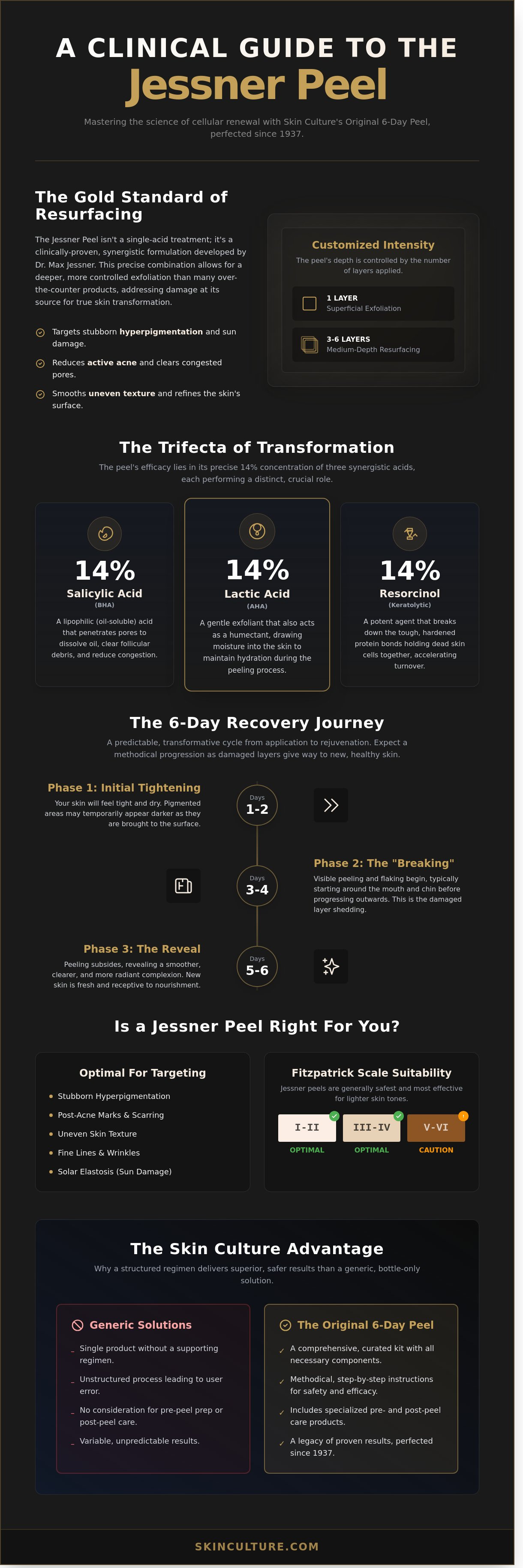
Is a Jessner-Type Peel Right for You? Skin Types and Expected Results
The ideal candidate for a classic Jessner peel is someone with oily, congested, or sun-damaged skin. It is highly effective for:
- Treating Acne and Congestion: Its salicylic acid content makes it a superior choice for clearing clogged pores and reducing inflammation.
- Addressing Hyperpigmentation: The combination of acids works to lift and fade sun spots, melasma, and post-acne marks.
- Anti-Aging Benefits: By stimulating cellular turnover and collagen production, the peel can soften the appearance of fine lines and improve overall skin texture.
The Fitzpatrick Scale and Safety
The Fitzpatrick scale, which classifies skin type based on its reaction to UV light, is a crucial tool for peel safety.
- Skin Types I-III (fair to light brown skin): Generally considered ideal candidates for traditional Jessner peels with a lower risk of complications.
- Skin Types IV-VI (darker skin tones): These skin types have more active melanocytes and are at a higher risk of developing post-inflammatory hyperpigmentation (PIH) if the skin is improperly treated or traumatized. This is where the controlled application of the Skin Culture Peel becomes paramount. The cream formula prevents the uneven penetration that can trigger PIH, making it a significantly safer and more predictable choice for darker skin.
Managing Expectations: Real-World Results
A single peel can produce a noticeable "glow" and improved clarity. However, for more significant concerns like deep acne scars or extensive sun damage, a series of treatments is often necessary. A successful peel cycle will result in smoother texture, more even tone, and diminished imperfections. It's crucial to understand that visible peeling is a biological response to the treatment, not a side effect. It is the desired outcome, signaling that the skin is shedding its damaged outer layers to reveal the new, healthy skin beneath.
The Peeling Journey: A Day-by-Day Recovery Guide
The recovery process follows a predictable 6-day timeline, which Skin Culture has perfected over decades. Understanding this journey helps eliminate anxiety and ensures you care for your skin properly.
- Day 1-2: The "Tightening" Phase: Immediately after the peel application is removed, the skin will feel tight and may look tan or bronzed. It is firm to the touch as the solution begins to work.
- Day 3-4: The "Breaking" Phase: The peeling process typically begins. Small flakes or sheets of skin will start to lift, usually starting around the mouth, nose, and chin where the skin has the most movement.
- Day 5-6: The "Shedding" Phase: This is the period of peak exfoliation. The old, damaged skin will shed, revealing the fresh, smooth, and radiant new skin underneath.
- The Golden Rule: Never, under any circumstances, pick, pull, or scrub at the peeling skin. Doing so can lead to scarring and hyperpigmentation. Allow the skin to shed naturally.
Essential Aftercare Protocol
Proper aftercare is just as important as the peel itself.
- Cleansing: Use only a gentle, soap-free cleanser and lukewarm water. Do not rub the skin; pat it dry with a soft towel.
- Hydration: Keep the skin moisturized with a neutral, non-irritating cream. Avoid any products containing active ingredients like retinoids, vitamin C, or other acids.
- Sun Protection: This is non-negotiable. The new skin is extremely sensitive to UV radiation. A broad-spectrum SPF 30+ must be applied daily during and after the recovery window.
Common Myths About the Peeling Process
- Myth: "If I don’t see sheets of skin, the peel didn’t work." The amount of visible peeling varies by individual. Some people experience fine, flaky shedding while others see larger sheets. Both are signs of a successful treatment.
- Myth: "I can use my retinol during the peeling phase." Absolutely not. Introducing active ingredients during the healing phase can cause severe irritation and compromise your results. Wait at least 10-14 days before reintroducing them.
Beyond the Jessner: Why Skin Culture’s Legacy is the Ultimate Choice
While the Jessner peel is a foundational treatment in dermatology, its effectiveness is limited by its liquid form and ingredient profile. Skin Culture's Original 6-Day Peel system represents the pinnacle of this 1930s resurfacing methodology, refined for superior safety and results at home.
The key difference is the transition from a simple "bottle-only" chemical to a complete, structured kit. A generic Jessner peel leaves aftercare and management to chance. The Skin Culture system guides your skin through the entire 6-day cycle with specialized products designed to work in harmony.
The Advantage of a Structured System
Our multi-step kits, trusted by thousands since 1937, ensure a predictable and successful outcome. The process includes not just the peeling cream but also the essential aftercare products formulated to support the skin's healing. The proprietary peeling cream, with its unique combination of Salicylic Acid, Resorcinol, and Phenol, is the engine of the transformation, delivering more profound results than a standard lactic-acid-based Jessner solution.
Your Path to Radiant Skin
Choosing the right treatment is the first step toward achieving your skin goals. By opting for a time-tested, safety-focused system, you can confidently address concerns like acne scars, sun damage, and fine lines. Regular, controlled skin resurfacing is one of the most effective ways to maintain a healthy, youthful complexion for the long term.
Ready to move from research to results? Restore your complexion with the Original Skin Peel 4000.
Frequently Asked Questions
How long does a Jessner peel take to heal completely? The primary peeling process lasts about 6-7 days. Your new skin may remain slightly pink and sensitive for another 7-10 days. Complete healing, with the skin returning to its normal state, typically takes about 14 days.
Can I do a Jessner peel at home safely? While generic liquid Jessner peels are available, they carry risks due to their runny consistency and potential for uneven application. A system like the Skin Culture Peel, which uses a thick cream in a structured kit, is designed specifically for safe and controlled at-home use.
What is the difference between a Jessner peel and a TCA peel? A Jessner peel is a combination of three acids (salicylic, lactic, resorcinol) that work synergistically. A TCA peel uses a single ingredient, Trichloroacetic Acid, which works by coagulating proteins in the skin. TCA peels are often more aggressive and can have a longer downtime.
Will a Jessner peel help with deep acne scars? A Jessner-type peel is excellent for textural irregularities and post-inflammatory hyperpigmentation (acne marks). For deep, "ice-pick" or "boxcar" scars, a series of peels is required to soften their appearance. The Skin Culture Peel 4000 is our strongest formulation, specifically designed for this purpose.
How many layers of Jessner peel should be applied? With a traditional liquid Jessner peel, practitioners apply 1-5 layers depending on the desired depth. However, this is not a concern with the Skin Culture Peel, as its cream formulation is applied in a single, even layer for a controlled and predictable result.
Is the Jessner peel painful during application? Users typically report a warm, tingling, or stinging sensation during the application of a Jessner or Skin Culture peel, which subsides after a few minutes. It is generally considered manageable and not intensely painful.
What should I avoid after getting a Jessner peel? For at least 14 days post-peel, you should avoid sun exposure, saunas, excessive sweating, exfoliating products (scrubs, retinoids, other acids), and picking or pulling at the peeling skin.
Can I use a Jessner peel if I have a dark skin tone? Darker skin tones (Fitzpatrick IV-VI) are at a higher risk of post-inflammatory hyperpigmentation with traditional liquid peels. The Skin Culture Peel's cream-based formula provides a much safer alternative, as its controlled application minimizes the risk of uneven penetration that can trigger this reaction.