


What if the secret to reversing sun damage on face at home isn't found in a $5,000 CO2 laser session, but in a disciplined six-day protocol performed in your own mirror? You've likely tried $185 Vitamin C serums or $36 Retinol treatments only to find your sunspots and fine lines remain stubbornly visible. It's frustrating when basic moisturizers fail to address the deeper structural damage caused by years of photoaging. We understand that persistent hyperpigmentation and a loss of skin elasticity require more than a surface-level solution.
You can achieve professional-level results and a clear, even skin tone by mastering our time-tested resurfacing method. This 2026 guide reveals how to effectively eliminate sunspots and fine lines using our original formulation, a legacy of clinical excellence since 1937. You'll learn the methodical steps of the Skin Culture 6-Day Skin Peel, which utilizes a precise blend of Resorcinol, Phenol, and Salicylic Acid to shed damaged layers. We'll walk you through the four-day application phase and the critical two-day shedding process to reveal the radiant, rejuvenated skin waiting beneath the surface.
Key Takeaways
- Understand why our formula of Resorcinol, Phenol, and Salicylic Acid provides a more intensive resurfacing than common TCA or glycolic peels.
- Discover the structured 6-day protocol for reversing sun damage on face at home, from the initial application phase to the final shedding of damaged skin.
- Evaluate the financial and physical advantages of home-based resurfacing compared to clinical laser procedures that often cost thousands.
- Learn why the Skin Peel 4000 is the most popular treatment for those seeking to restore cellular health and eliminate persistent hyperpigmentation.
- Recognize the critical importance of post-treatment moisturizers and broad-spectrum SPF to protect your radiant, newly revealed epidermis.
Understanding Facial Sun Damage and the Limits of Topical Creams
Sun damage is a biological alteration rather than a simple cosmetic flaw. UV radiation penetrates the dermis to trigger cumulative DNA mutations and the degradation of collagen fibers. This process induces characteristic changes to skin, including solar lentigines (sunspots) and solar elastosis. When you're researching reversing sun damage on face at home, you must recognize that these mutations reside deep within the cellular matrix. Basic topical creams fail to reach these depths, leaving the underlying damage untouched.
To better understand the biological impact of UV exposure and how to address it, watch this helpful video:
The Difference Between Surface Brightening and Deep Resurfacing
Brightening serums are often the first choice for individuals frustrated by uneven tone. These products focus on the surface layer of the epidermis. They work slowly and frequently reach a plateau when faced with years of UV accumulation. Intensive resurfacing is different. It's a corrective skin transformation that removes the damaged layers entirely. Since 1937, Skin Culture has provided a reliable path to skin health using a precise formula of Resorcinol, Phenol, and Salicylic Acid. These are not standard glycolic peels; they are professional-grade solutions designed for deep-tissue repair.
When Home Remedies Like Aloe and Vinegar Fall Short
You might encounter suggestions for "kitchen" remedies like lemon juice or vinegar to fade sunspots. These methods are often ineffective and carry a high risk of chemical irritation or uneven results. A structured at-home chemical peel offers a safer, more methodical approach. Our six-day protocol is designed with precision. You'll move through an application phase during Days 1-4, followed by a transformative peeling phase on Days 5-6. This disciplined process is why the Skin Peel 4000 is our most popular treatment. It provides the clarity and rejuvenation that DIY remedies simply can't achieve.
The Science of Resurfacing: Key Ingredients for UV Repair
Resurfacing is the methodical process of removing damaged epidermal layers to stimulate the growth of healthy, fresh tissue. When you're reversing sun damage on face at home, you aren't just applying a daily serum; you're facilitating a profound cellular transformation. Unlike superficial treatments that only address the skin's surface, our formulation targets the long-term changes in the skin's structure caused by chronic UV radiation. This process forces the body to shed the accumulated evidence of photoaging, revealing the radiant skin beneath.
The efficacy of this treatment relies on three specific dermatological ingredients. Resorcinol is essential for breaking down the stubborn cellular bonds of hyperpigmented tissue. Salicylic Acid clears the pores and prepares the skin's surface for deep renewal, while Phenol addresses deep-seated fine lines and texture issues. This triad works in synergy to lift away the evidence of photoaging. It's a disciplined approach to skin health that has remained the gold standard for those who value results over fleeting beauty trends.
Beyond TCA and Glycolic: Why the Blend Matters
It's important to clarify that our professional home kits are not standard TCA, Glycolic, or Jessner peels. Since 1937, Skin Culture has utilized a proprietary, stabilized blend of Resorcinol, Phenol, and Salicylic Acid. This specific combination is designed to target solar lentigines and uneven texture without the unpredictability of single-acid formulas found in many modern products. This triad provides a controlled and uniform peel that effectively targets sun-induced pigmentation at its source. While the strength of the formulation is identical across our range, the results depend on the quantity of jars used and the duration of the application.
Moisturization as a Critical Component of the Peeling Process
During the transformation, moisturization is a functional requirement rather than a luxury. During the application phase (Days 1-4), the formulation penetrates the damaged layers. By the peeling and shedding phase (Days 5-6), your skin will form a dry, mask-like layer of dead tissue. You must apply the specialized moisturizer frequently during these final days to ensure a successful reveal. This step is critical for softening the dead skin, allowing it to lift away safely to reveal the fresh tissue underneath. Without proper hydration, the old skin remains brittle, which can hinder the renewal process. For those seeking the most intensive results, the Skin Peel 4000 remains our most popular choice for deep sun damage correction.
Clinical Lasers vs. Professional Home Peels: A Comparison
The cost-benefit analysis of clinical procedures versus home treatments is a primary concern for many. While CO2 laser resurfacing can cost between $1,500 and $5,000 per session as of March 14, 2026, the financial commitment doesn't end there. Most patients require multiple sessions to achieve significant results. When you choose the path of reversing sun damage on face at home, you eliminate the overhead costs of the clinic while utilizing a formula with a proven pedigree. The chemical peel price for a professional home kit offers a higher return on investment by providing deep resurfacing in a single six-day cycle.
Laser therapy presents specific risks, particularly for those with darker skin tones. Laser-induced post-inflammatory hyperpigmentation (PIH) is a documented concern where the heat from the device triggers excess melanin production. Our chemical resurfacing method avoids this heat-based trauma. You should understand that these are not TCA, glycolic, or Jessner peels. Instead, we utilize a stabilized blend of Resorcinol, Phenol, and Salicylic Acid to achieve a controlled exfoliation of the epidermis without the thermal risks associated with light-based devices.
Laser Resurfacing: Pros, Cons, and Hidden Costs
Clinical lasers are categorized as ablative or non-ablative. Ablative lasers remove thin layers of skin but often require significant recovery time. Non-ablative lasers, costing between $400 and $1,250 per session as of January 2026, are less invasive but frequently fail to address deep-seated solar lentigines in a single visit. Fraxel laser treatments, which cost between $900 and $1,500 as of September 2024, also typically require multiple appointments to be effective. You must also consider the downtime debate. Laser recovery can involve weeks of redness and sensitivity. In contrast, our 6-Day Skin Peel follows a predictable, methodical schedule that fits your life.
The Advantage of the 6-Day Controlled Home Peel
Reliability is the cornerstone of the Skin Culture experience. Since our founding in 1937, we've provided "The Original" solution for those frustrated by persistent UV damage. The Skin Peel 4000 is the preferred choice for individuals dealing with severe photoaging because it provides the most comprehensive resurfacing in our range. You'll apply the formulation over four days to saturate the damaged tissue. As the peeling phase begins on Day 5, you'll use our specialized moisturizer to soften the old skin. This ensures the dead cells shed cleanly to reveal the rejuvenated tissue underneath. It's a disciplined, no-nonsense path to skin health that has outlasted decades of fleeting beauty trends.
The 6-Day Protocol: How to Safely Reverse Damage at Home
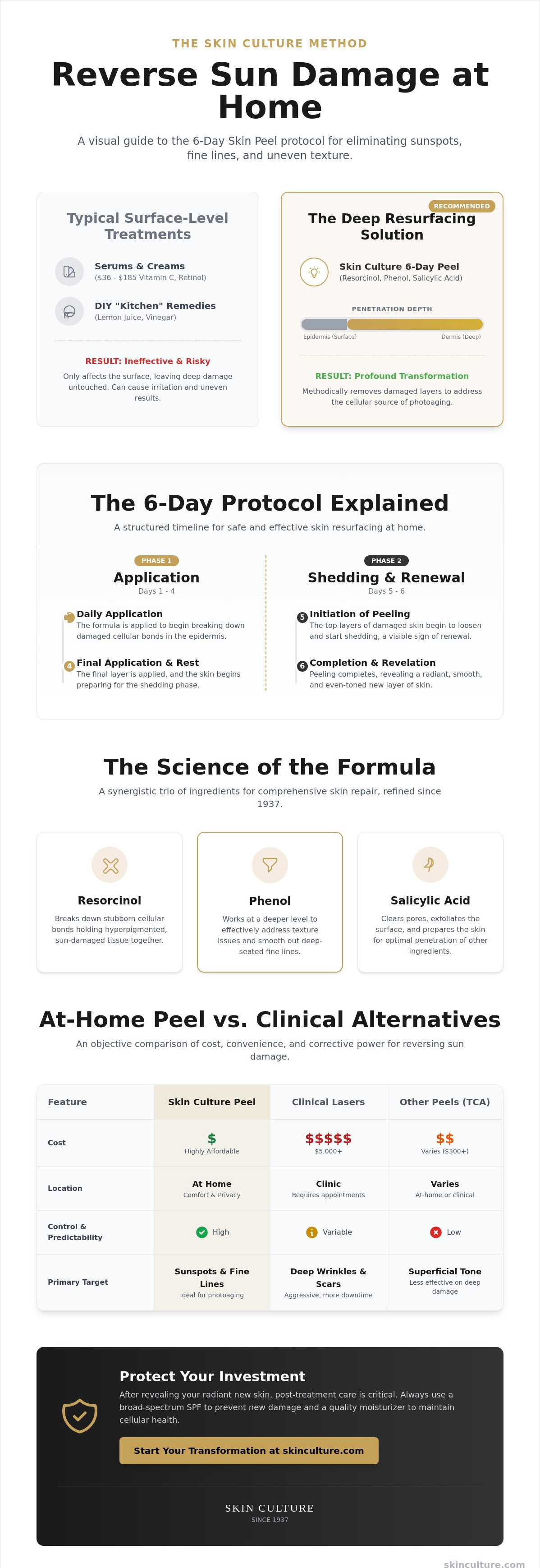
Reversing sun damage on face at home requires a disciplined adherence to a structured, multi-day schedule. Unlike the disorganized tips often found on social forums, our 6-day protocol is a methodical dermatological procedure established in 1937. This process is divided into two distinct stages: the application phase and the peeling phase. By following this sequence, you ensure that the specialized formulation of Resorcinol, Phenol, and Salicylic Acid reaches the damaged cellular structures effectively. You are not just applying a cream; you are managing a controlled skin transformation.
Days 1 to 4: The Strategic Application
You'll begin the process by applying the treatment jars according to the tier you have selected. For the Skin Peel 2000, you'll apply two jars over two days. The Skin Peel 3000 requires three jars over three days. For those seeking the most intensive results, the Skin Peel 4000 involves applying four jars over four consecutive days. It's important to remember that the strength of the formulation is identical across all tiers; the variation in results comes from the cumulative effect of the quantity used and the duration of the application.
You apply the cream in a thick, uniform layer over the treatment area. During these initial days, you'll experience a distinct tightening sensation as the formula penetrates the epidermis. This feeling indicates that the active ingredients are successfully breaking down the hyperpigmented cellular bonds. By the end of the fourth day, the skin will appear darker and feel quite firm, signaling that the application phase is complete and the skin is prepared for renewal.
Days 5 and 6: The Transformation and Reveal
The peeling and shedding phase typically begins on Day 5. You'll likely notice the first signs of lifting around the mouth and nose, where the skin is most active. The old, damaged tissue will resemble a dry mask as it separates from the fresh epidermis underneath. You must never pick, pull, or peel this skin manually. Forcing the shedding process can cause irritation or damage to the vulnerable new tissue.
The specialized moisturizer is a critical agent for softening the dead skin to ensure it sheds smoothly and reveals the rejuvenated skin underneath. You should apply this moisturizer frequently during the final 48 hours to facilitate an even peel. Once the shedding is complete by the end of Day 6, you'll see a visible reduction in sunspots and fine lines. To achieve this level of professional clarity, you can start your journey with the Skin Peel 4000, our most popular and comprehensive treatment for severe UV damage.
Maintaining Your Results: Protection After Resurfacing
Once you've successfully completed the six-day transformation, your focus must shift from correction to preservation. The new epidermis revealed after the peeling and shedding phase (Days 5-6) is highly sensitive and requires a disciplined protection strategy. The 'Golden Rule' of post-resurfacing care is the daily application of a broad-spectrum SPF. This is non-negotiable. Without consistent UV protection, the fresh tissue is susceptible to rapid re-pigmentation, undoing your progress in reversing sun damage on face at home. You've worked hard to shed the damaged layers accumulated over years; protecting the new skin is the only way to maintain that clarity.
As you monitor your progress, you'll reach specific chemical peel before and after milestones. In the first few weeks, you'll observe increased clarity and a smoother texture as the skin continues to heal. For deep-set damage or severe photoaging, a single treatment may not be sufficient. While the strength of our formula—containing Resorcinol, Phenol, and Salicylic Acid—is identical across our range, the depth of the result depends on whether you used the Skin Peel 2000, 3000, or our most popular choice, the Skin Peel 4000. If persistent spots remain, you may plan a second treatment after your skin has fully rested for at least 30 to 45 days.
Post-Peel Skincare: The First 30 Days
During the first month following your 6-Day Skin Peel, your skin's barrier is in a state of active renewal. You must avoid harsh active ingredients such as prescription retinoids, glycolic peels, or TCA peels. These can cause unnecessary irritation to the new, vulnerable tissue. Instead, prioritize gentle cleansing and intense hydration. Your skin is exceptionally receptive to nutrients now that the old, dry barrier has been removed. Use our specialized moisturizer to maintain hydration levels and support the cellular health of your rejuvenated face. This step ensures the new skin remains soft and resilient.
Sun Damage Prevention: Future-Proofing Your Face
Future-proofing your results involves more than just a single application of sunscreen. You should adopt advanced protection strategies, including wearing wide-brimmed hats and seeking shade during peak UV hours. Detect new damage early by performing regular skin checks for changes in pigmentation or texture. Since 1937, Skin Culture has helped thousands achieve lasting skin health through methodical resurfacing. If you're ready to address years of UV exposure with a proven, clinical solution, you can Start your 6-day transformation with the Skin Peel 4000.
Begin Your Journey Toward Skin Longevity
Achieving a radiant and even complexion requires moving beyond temporary surface fixes. By choosing a structured path for reversing sun damage on face at home, you're opting for a method that addresses photoaging at its cellular foundation. You've learned that our formula of Resorcinol, Phenol, and Salicylic Acid provides a controlled transformation, moving precisely from the four-day application phase to the final reveal on Day 6. This disciplined approach ensures that damaged tissue is shed safely, allowing your fresh epidermis to emerge without the high costs or thermal risks of clinical lasers.
Since 1937, Skin Culture has remained the pioneer in at-home resurfacing. Our original 6-day peel has been trusted by thousands of individuals seeking professional results from the privacy of their own homes. Whether you're targeting deep-set sunspots or fine lines, the Skin Peel 4000 offers our most comprehensive solution for visible rejuvenation. It's time to stop settling for persistent skin issues and start trusting a legacy of proven efficacy.
Discover the Skin Peel 4000: Our Most Powerful Solution for Sun Damage
You deserve skin that reflects your health and vitality. We're here to guide you through every step of your transformation and help you achieve the clarity you've been searching for.
Frequently Asked Questions
Can I really reverse years of sun damage at home?
Yes, you can effectively achieve a clear tone by reversing sun damage on face at home using a professional resurfacing treatment. Our 6-Day Skin Peel uses a methodical approach to shed the damaged epidermis. This process removes the accumulated evidence of photoaging, such as solar lentigines and fine lines. Since 1937, thousands have used this original formula to restore skin health without the clinical price tag.
How many days does it take to see results from a home skin peel?
The entire transformation requires exactly six days to complete. You'll spend the first four days in the application phase, during which the formula saturates the damaged tissue. On Days 5 and 6, the peeling and shedding phase occurs. Once the old skin is fully removed, the rejuvenated, radiant tissue is immediately visible underneath. It's a structured process that delivers a professional-level result without a clinic visit.
Is it safe to do a deep chemical peel on my own face?
It is safe to perform this resurfacing at home provided you follow our precise, sequential instructions. Our formula is a stabilized blend of Resorcinol, Phenol, and Salicylic Acid, which is distinct from unpredictable TCA or glycolic peels. We have maintained a legacy of safety and efficacy for nearly 90 years. You must simply ensure you don't pick or pull at the skin during the shedding phase.
What is the difference between the Skin Peel 2000, 3000, and 4000?
The difference between these tiers is the quantity of jars and the duration of the application phase. You'll receive two jars for the 2000, three for the 3000, and four for the 4000. The chemical strength of the formulation remains identical across all products. The Skin Peel 4000 is our most popular treatment because it provides the most intensive results for severe UV damage and persistent hyperpigmentation.
Will a home peel get rid of dark sunspots (liver spots)?
Yes, this treatment is specifically designed to eliminate hyperpigmented cellular bonds. By removing the damaged layers of the epidermis, the peel lifts away dark sunspots that don't respond to basic moisturizers. The result is a more even skin tone and a visible reduction in photoaging. Consistency in post-peel sun protection is essential to maintain these results and prevent new damage from forming on the fresh tissue.
Can I go outside during the 6-day peeling process?
You should avoid direct sun exposure during the entire six-day protocol. Your skin will be in a state of active transformation, and the new tissue revealed on Days 5 and 6 is exceptionally vulnerable. If you must go outside, use a wide-brimmed hat and broad-spectrum SPF. Protecting the new epidermis is a critical step for long-term skin health and ensuring the success of your resurfacing treatment.
What ingredients should I look for in a sun damage repair kit?
You should look for a synergistic blend of Resorcinol, Phenol, and Salicylic Acid for effective resurfacing. These ingredients work together to break down damaged tissue and clear pores. It's important to note that our formula contains no TCA or glycolic acids. This specific triad has been our hallmark since 1937, providing a reliable and trusted path for reversing sun damage on face at home.
Does the skin peel hurt during the application phase?
You'll feel a tightening and stinging sensation during the application phase (Days 1-4). This is a normal part of the process as the formula penetrates the damaged layers. The sensation is manageable and indicates that the resurfacing is working as intended. Using the specialized moisturizer on Days 5 and 6 helps soften the old skin, making the final shedding process comfortable and ensuring a smooth reveal of the new skin.